
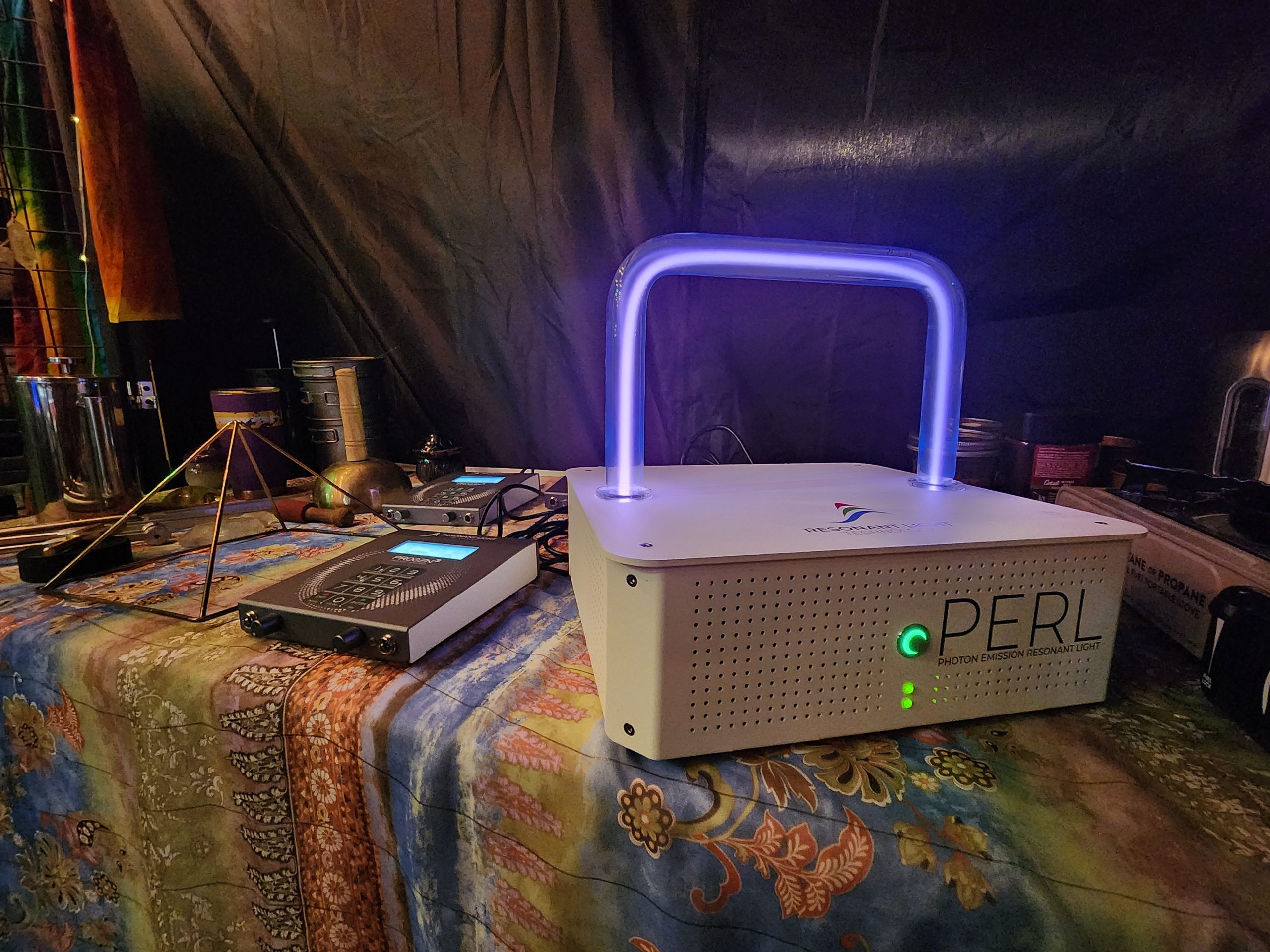
The PERL, short for Photon Emission Resonant Light, is a frequency device made by Resonant Light Technology. A frequency generator produces a programmed set of frequencies, and the PERL emits them through a glass tube filled with argon gas. When the device runs, the argon becomes a glowing plasma and the tube lights the room. The manufacturer describes a range of about 30 feet around the tube, so no pads or contact are needed (Resonant Light Technology, n.d.), and describes the output as a pulsed electromagnetic field, or PEMF, carried on a radio-frequency signal (Resonant Light Technology, 2026). Plasma-tube devices in this line are typically driven by a 27.12 MHz radio transmitter whose signal is modulated at audio frequencies (Le Chapellier & Matta, 2014).
The design belongs to the Rife tradition of frequency devices, which the manufacturer traces to Royal Raymond Rife and later plasma-tube work by James Bare and others (Resonant Light Technology, n.d.).
How we use it
We offer the PERL as an ambient light and field environment for relaxation. The glowing tube, the quiet room, and the time set apart are the experience. It is not offered as a medical device or as a cure for any disease.
What is established
Two pieces of physics are settled. A gas-discharge tube driven by an electrical signal gives off visible light, which is why the PERL glows. And a magnetic field that changes over time induces small electrical currents in anything that conducts, including the body; this is the physical principle behind every PEMF device. Pulsed electromagnetic field devices are also more than a wellness idea: the U.S. Food and Drug Administration has approved them as a safe and effective treatment for bone fractures that fail to heal, called nonunions (Cadossi et al., 2020). Those approved devices are coil-based bone stimulators, not plasma tubes.
Where the evidence is mixed
Clinical trials of PEMF point in different directions. A meta-analysis of 22 randomized trials found that PEMF raised fracture healing rates compared with sham, with healing in 79.7% of PEMF groups and 64.3% of control groups across 14 trials (risk ratio 1.22, 95% CI 1.10 to 1.35), and rated that evidence moderate in quality (Peng et al., 2020). A later systematic review update did not support PEMF for improving healing of acute fractures and found the evidence on pain and function controversial (Picelli et al., 2024). For painful diabetic neuropathy, a meta-analysis found that electrical stimulation (TENS) reduced pain, while electromagnetic field treatment did not differ significantly from control (Stein et al., 2013).
All of this evidence is indirect for the PERL. The trials tested coil devices placed on or near the body with measured field strengths. We are not aware of controlled trials of the PERL itself, and the field it delivers to a person seated across the room has not, to our knowledge, been measured in published work.
What remains a model
Laboratory work offers proposed mechanisms. One review argues that electromagnetic fields act mainly by opening voltage-gated calcium channels in cell membranes (Pall, 2013); others describe PEMF acting on adenosine receptors in bone and cartilage cells (Cadossi et al., 2020). These are credible models from cell and animal studies, and they remain contested. A review of PEMF in oncology reported encouraging laboratory and animal findings but noted that only limited use in people has been documented (Vadalà et al., 2016). Whether specific frequencies from a plasma tube produce specific effects in the body has not been tested in controlled human studies.
What we do not claim
An independent review of the original Rife machine concluded that Rife’s identification of frequencies for specific pathogens, and the ability of Rife machines to kill pathogens, “are all unproven and highly implausible” (ALSUntangled Group, 2014, Conclusions section). The only published clinical report we know of involving the PERL is a single case in which the patient also received chemotherapy, so the device’s contribution cannot be separated from the medical treatment (Le Chapellier & Matta, 2014). We do not claim that the PERL treats, cures, or prevents any disease.
References
ALSUntangled Group. (2014). ALSUntangled No. 23: The Rife machine and retroviruses. Amyotrophic Lateral Sclerosis and Frontotemporal Degeneration, 15(1–2), 157–159. https://doi.org/10.3109/21678421.2013.850802
Cadossi, R., Massari, L., Racine-Avila, J., & Aaron, R. K. (2020). Pulsed electromagnetic field stimulation of bone healing and joint preservation: Cellular mechanisms of skeletal response. JAAOS: Global Research and Reviews, 4(5), Article e19.00155. https://doi.org/10.5435/JAAOSGlobal-D-19-00155
Le Chapellier, P., & Matta, B. (2014). Is victory over pancreatic cancer possible, with the help of tuned non-invasive physiotherapy? A case study says yes. Journal of Cancer Therapy, 5(5), 460–477. https://doi.org/10.4236/jct.2014.55053
Pall, M. L. (2013). Electromagnetic fields act via activation of voltage-gated calcium channels to produce beneficial or adverse effects. Journal of Cellular and Molecular Medicine, 17(8), 958–965. https://doi.org/10.1111/jcmm.12088
Peng, L., Fu, C., Xiong, F., Zhang, Q., Liang, Z., Chen, L., He, C., & Wei, Q. (2020). Effectiveness of pulsed electromagnetic fields on bone healing: A systematic review and meta-analysis of randomized controlled trials. Bioelectromagnetics, 41(5), 323–337. https://doi.org/10.1002/bem.22271
Picelli, A., Di Censo, R., Tomasello, S., Scaturro, D., Letizia Mauro, G., Smania, N., & Filippetti, M. (2024). Effects of pulsed electromagnetic fields on bone fractures: A systematic review update. European Journal of Physical and Rehabilitation Medicine, 60(6), 989–994. https://doi.org/10.23736/S1973-9087.24.08226-1
Resonant Light Technology. (2026). How frequencies resonate: Official ebook (2026 ed.) [Ebook].
Resonant Light Technology. (n.d.). New PERL. Retrieved September 30, 2026, from https://www.resonantlight.com/new-perl/
Stein, C., Eibel, B., Sbruzzi, G., Lago, P. D., & Plentz, R. D. M. (2013). Electrical stimulation and electromagnetic field use in patients with diabetic neuropathy: Systematic review and meta-analysis. Brazilian Journal of Physical Therapy, 17(2), 93–104. https://doi.org/10.1590/S1413-35552012005000083
Vadalà, M., Morales-Medina, J. C., Vallelunga, A., Palmieri, B., Laurino, C., & Iannitti, T. (2016). Mechanisms and therapeutic effectiveness of pulsed electromagnetic field therapy in oncology. Cancer Medicine, 5(11), 3128–3139. https://doi.org/10.1002/cam4.861