
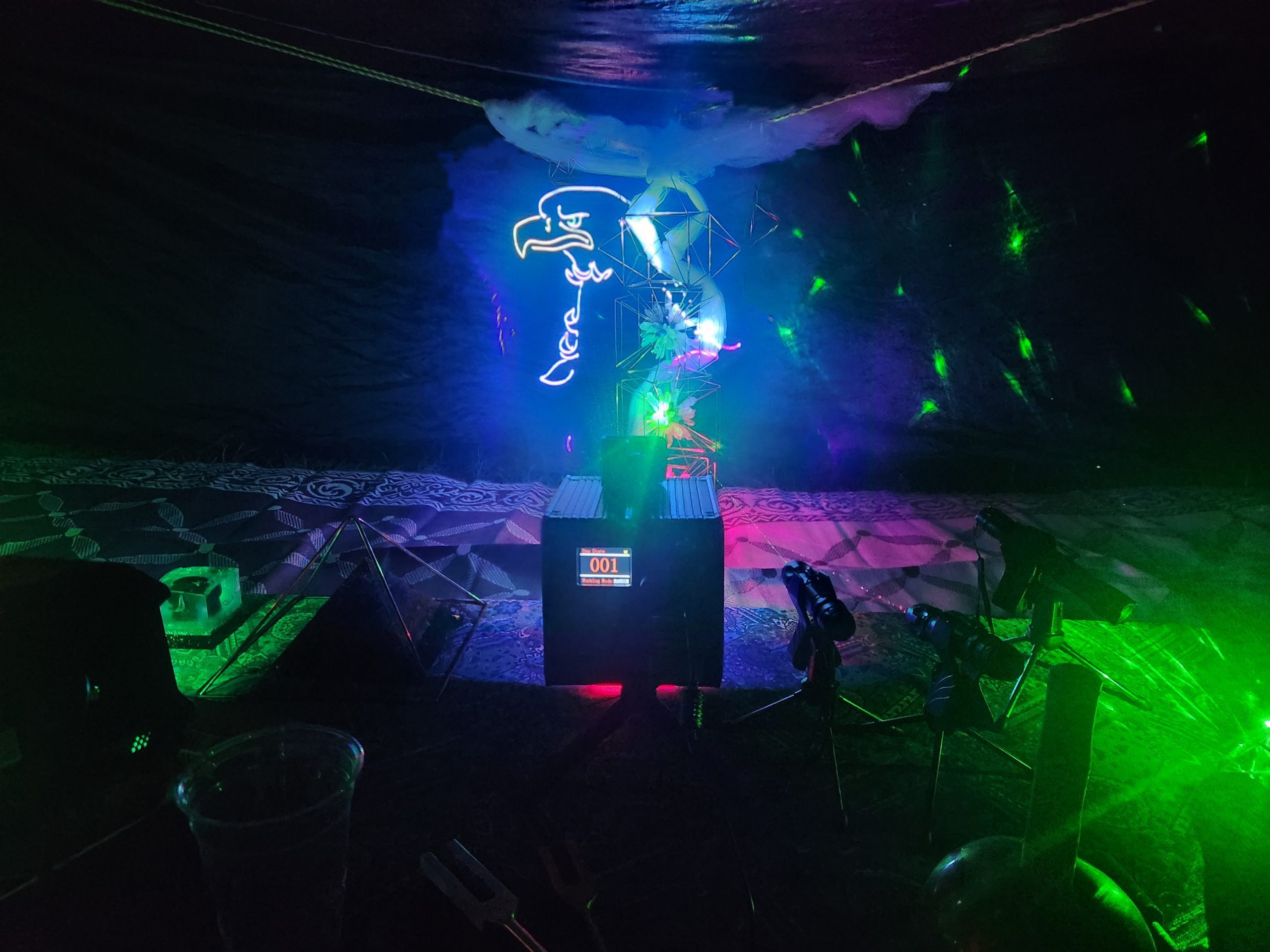
Luminous Architecture is the deliberate composition of light, optics, geometry, material, and spatial relationships to create an immersive sensory environment. It extends beyond conventional illumination by treating light as both a physical phenomenon and a medium of spatial expression. Rather than merely lighting a room, Luminous Architecture organizes how light appears, travels, intersects with surfaces, defines boundaries, and shapes the experience of being within a space.
How Light Becomes Architecture
The practice draws on principles from architectural lighting, optical physics, environmental psychology, and experiential design. Lasers provide narrow, directional beams with the physical properties of coherent light (Hecht, 2017). Refractive and reflective materials alter the paths and distribution of light according to their optical properties. Spatial geometry, contrast, movement, scale, and darkness determine how these elements are perceived in relation to one another. The resulting environment may be static or dynamic, contemplative or stimulating, minimal or densely layered.
A beam in perfectly clear air is hard to see from the side. It becomes visible when fog, haze, or dust scatters part of its light toward the viewer (Bohren & Huffman, 1983), which is how a fanned beam can read as a ceiling, a wall, or a doorway where no surface exists. The visual system then groups aligned, nearby, or co-moving beams into larger forms (Wagemans et al., 2012), and darkness makes them stand out, because what draws the eye depends on its surroundings (Itti & Koch, 2001).
What It Builds
- Planes: fanned beams that read as ceilings, walls, or canopies in haze.
- Thresholds: frames or curtains of light that mark the moment of entering, as in a portal.
- Paths: lines or sequences of light that show where to walk.
- Geometry: crystals that redirect beams into points and lines across walls, fabric, and foliage.
- The site itself: trees, rocks, water, and existing structures that receive the light and become part of the design.
Material and Meaning
At Mountain’s Daughter Health, Luminous Architecture also incorporates a symbolic vocabulary of material and form. Quartz may represent clarity, transmission, crystalline order, and the relationship between structure and light. Shungite may represent density, grounding, containment, and the material conditions of the earth. Their placement establishes a visual and spatial dialogue between luminosity and mass, transparency and opacity, emergence and stability. These meanings belong to the design philosophy; they should not be confused with demonstrated physiological or electromagnetic effects of the stones. Quartz is piezoelectric and shungite can shield microwave radiation when prepared as thin, carbon-rich plates, but neither property means a stone in a room changes the people around it (Antonets et al., 2021; International Union of Crystallography, n.d.).
What the Research Supports
The practice is informed by research showing that light affects visual perception, circadian timing, alertness, and mood (Xiao et al., 2021), as well as environmental-psychology research on restorative settings (Kaplan, 1995; Ulrich et al., 1991). However, evidence for these broader relationships does not establish that a specific arrangement of lasers, crystals, or mineral objects produces a particular therapeutic outcome.
Design Principles
- Spatial legibility: deliberate visual relationships, focal points, transitions, and boundaries.
- Optical intentionality: beam direction, refraction, reflection, contrast, and visibility designed according to actual optical properties.
- Material dialogue: materials used for their physical properties and for stated symbolic meanings, with the two kept distinct.
- Sensory modulation: attention to intensity, movement, sound, complexity, duration, and individual sensory differences, including flicker, which can trigger seizures in people who are photosensitive (Fisher et al., 2005).
- Participant agency: the freedom to move, disengage, adjust exposure, and interpret the environment independently.
- Evaluability: design and exposure conditions documented so that experiences and possible physiological outcomes can be studied.
Laser light shows in the United States are regulated, with limits on the power that may reach an audience (U.S. Food and Drug Administration, n.d.). In our installations, beams are positioned above and away from where people stand.
Conceptual principle: Light is not merely an object within the architecture. It is one of the media through which the architecture becomes perceptible.
Application: Immersive installations, sensory environments, light-based experiential art, contemplative spaces, workshops, and experimental wellness environments.
Evidence status: The optical and photobiological principles underlying the practice are established. Luminous Architecture, as defined here, is a Mountain’s Daughter Health design framework. Its specific experiential and physiological effects require evaluation.
Related Terms
Environmental Coherence · Photic Lustration · Coherence · Coherent Light · Laser · Piezoelectricity · Portal of Light · Field of Becoming · Auric Structuring · Structural Coherence
References
Antonets, I. V., Golubev, Y. A., Shcheglov, V. I., & Sun, S. (2021). Electromagnetic shielding effectiveness of lightweight and flexible ultrathin shungite plates. Current Applied Physics, 29, 97–106. https://doi.org/10.1016/j.cap.2021.06.008
Bohren, C. F., & Huffman, D. R. (1983). Absorption and scattering of light by small particles. Wiley.
Fisher, R. S., Harding, G., Erba, G., Barkley, G. L., & Wilkins, A. (2005). Photic- and pattern-induced seizures: A review for the Epilepsy Foundation of America Working Group. Epilepsia, 46(9), 1426–1441. https://doi.org/10.1111/j.1528-1167.2005.31405.x
Hecht, E. (2017). Optics (5th ed.). Pearson.
International Union of Crystallography. (n.d.). Piezoelectricity. Online Dictionary of Crystallography. https://dictionary.iucr.org/Piezoelectricity
Itti, L., & Koch, C. (2001). Computational modelling of visual attention. Nature Reviews Neuroscience, 2(3), 194–203. https://doi.org/10.1038/35058500
Kaplan, S. (1995). The restorative benefits of nature: Toward an integrative framework. Journal of Environmental Psychology, 15(3), 169–182. https://doi.org/10.1016/0272-4944(95)90001-2
Ulrich, R. S., Simons, R. F., Losito, B. D., Fiorito, E., Miles, M. A., & Zelson, M. (1991). Stress recovery during exposure to natural and urban environments. Journal of Environmental Psychology, 11(3), 201–230. https://doi.org/10.1016/S0272-4944(05)80184-7
U.S. Food and Drug Administration. (n.d.). Laser light shows. https://www.fda.gov/radiation-emitting-products/home-business-and-entertainment-products/laser-light-shows
Wagemans, J., Elder, J. H., Kubovy, M., Palmer, S. E., Peterson, M. A., Singh, M., & von der Heydt, R. (2012). A century of Gestalt psychology in visual perception: I. Perceptual grouping and figure-ground organization. Psychological Bulletin, 138(6), 1172–1217. https://doi.org/10.1037/a0029333
Xiao, H., Cai, H., & Li, X. (2021). Non-visual effects of indoor light environment on humans: A review. Physiology & Behavior, 228, Article 113195. https://doi.org/10.1016/j.physbeh.2020.113195