
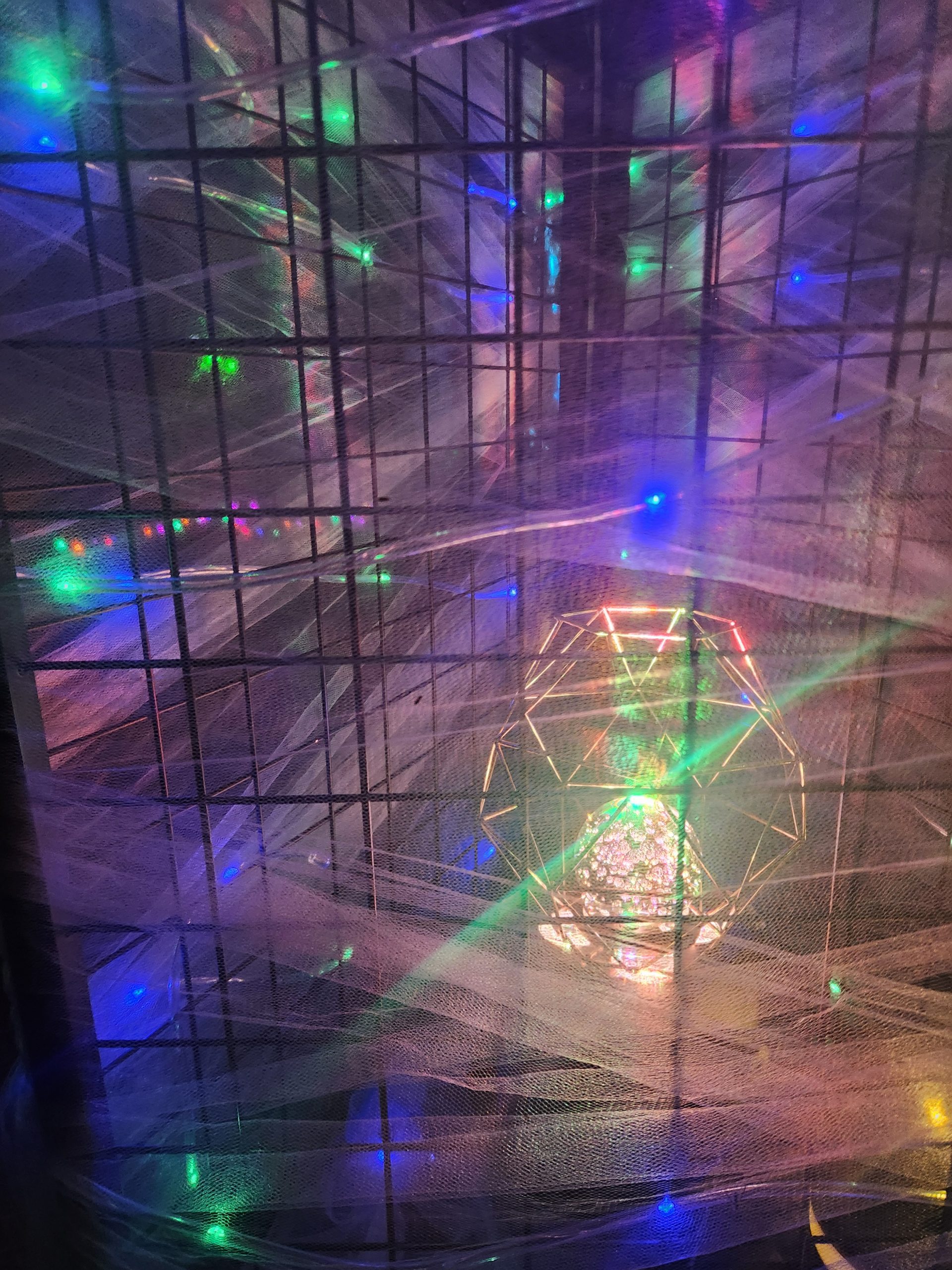
Crystallization of the Aura is the foundational concept of Auric Structuring™. It names the process of organizing, strengthening, and increasing the perceived structural coherence of the auric field through intentional interaction with crystalline forms, light, color, environment, and embodied experience.
A crystal is a helpful picture. Its atoms settle into a repeating, ordered pattern, and light that passes through it comes out broken into edges, colors, and geometry. Crystallization of the Aura borrows that image for a person’s field of experience: attention and presence settling into a clearer shape.
How we use it
It is the organizing idea behind Field of Becoming and the Portal of Light, where visitors step into an environment of crystal and coherent light and let the space shape their experience.
Where it sits
This is a conceptual and experiential idea, not a physiological claim. The key word is perceived. It describes what a person may notice and feel inside the work.
The aura in history
The idea of a luminous field around a person is very old. Painters gave saints halos, and many traditions describe a radiant or subtle body surrounding the physical one. Indian traditions speak of prana, Chinese medicine of qi, and Japanese practice of ki.
In 1992, a committee convened by the U.S. National Institutes of Health proposed the word biofield to give researchers a shared term for these ideas (Rubik et al., 2015). Today the word is used most carefully for fields the body is known to produce, such as the electrical and magnetic rhythms of the heart and brain and the small electrical currents that guide wound repair (Hammerschlag et al., 2015). In the Library, aura and light body remain tradition words and biofield remains a research word. We keep them apart on purpose.
What science has measured
The body really does glow. Sensitive cameras working in total darkness have recorded faint light from human skin, strongest in the late afternoon and about a thousand times too dim for the eye to see (Kobayashi et al., 2009). This light comes from the everyday chemistry of metabolism, especially reactive oxygen species. Researchers agree the light is real. They have not found reliable evidence that it is coherent, the ordered, in-step kind of light a laser produces (Cifra et al., 2015).
The heart and brain also produce magnetic fields, but they are extremely faint. The brain’s field was first recorded only inside a magnetically shielded room, with many readings averaged together (Cohen, 1968).
Why we say perceived
Many people describe seeing or sensing an aura, and psychologists study this as a real experience that differs from person to person. In one survey of 212 adults, those who reported seeing auras scored higher on transliminality, a tendency for images, feelings, and ideas to cross easily into awareness (Parra, 2015). Aura reports also differ from synaesthesia, the blending of the senses, so that explanation does not fully account for them (Milán et al., 2012).
We speak of the aura as perceived coherence: a felt sense of order and clarity that light, crystal, and space can invite. It is real as experience, and experience is where we work with it.
Where the crystal meets the person
Two kinds of light are easy to confuse. The body’s own light flows outward and is far too faint to see. The light in an Auric Structuring space flows inward, toward the eyes. Light that enters the skin is quickly scattered, and polarization, one of the ordered qualities of laser light, is likely lost within the first fraction of a millimeter (Huang et al., 2009). The order of coherent light lives in the room and in what you see, you change your own field and aura, we just invite you into that process.
When people breathe slowly, the heart’s rhythm rises and falls in a smooth, regular wave, a pattern researchers find in almost everyone (Lehrer & Gevirtz, 2014). In a small trial, 30 minutes in a dim, comfortable sensory room raised a marker of the body’s calming nervous system more than quiet crafts did, though mood did not differ between the groups (Otsuka et al., 2025). In a lab study, immersive awe-inspiring videos raised feelings of awe, and awe was linked with greater activity in that same calming branch of the nervous system (Chirico et al., 2017).
These findings come from settings like ours, not from measurements taken inside the Portal of Light or Field of Becoming. They suggest why a calm, luminous, crystalline space might help attention settle. Crystallization of the Aura names how that settling can feel from the inside.
Sources
Chirico, A., Cipresso, P., Yaden, D. B., Biassoni, F., Riva, G., & Gaggioli, A. (2017). Effectiveness of immersive videos in inducing awe: An experimental study. Scientific Reports, 7(1), Article 1218. https://doi.org/10.1038/s41598-017-01242-0
Cifra, M., Brouder, C., Nerudová, M., & Kučera, O. (2015). Biophotons, coherence and photocount statistics: A critical review. Journal of Luminescence, 164, 38–51. https://doi.org/10.1016/j.jlumin.2015.03.020
Cohen, D. (1968). Magnetoencephalography: Evidence of magnetic fields produced by alpha-rhythm currents. Science, 161(3843), 784–786. https://doi.org/10.1126/science.161.3843.784
Hammerschlag, R., Levin, M., McCraty, R., Bat, N., Ives, J. A., Lutgendorf, S. K., & Oschman, J. L. (2015). Biofield physiology: A framework for an emerging discipline. Global Advances in Health and Medicine, 4(Suppl), 35–41. https://doi.org/10.7453/gahmj.2015.015.suppl
Huang, Y.-Y., Chen, A. C.-H., Carroll, J. D., & Hamblin, M. R. (2009). Biphasic dose response in low level light therapy. Dose-Response, 7(4), 358–383. https://doi.org/10.2203/dose-response.09-027.Hamblin
Kobayashi, M., Kikuchi, D., & Okamura, H. (2009). Imaging of ultraweak spontaneous photon emission from human body displaying diurnal rhythm. PLoS ONE, 4(7), Article e6256. https://doi.org/10.1371/journal.pone.0006256
Lehrer, P. M., & Gevirtz, R. (2014). Heart rate variability biofeedback: How and why does it work? Frontiers in Psychology, 5, Article 756. https://doi.org/10.3389/fpsyg.2014.00756
Milán, E. G., Iborra, O., Hochel, M., Rodríguez-Artacho, M., Delgado-Pastor, L. C., Salazar, E., & González-Hernández, A. (2012). Auras in mysticism and synaesthesia: A comparison. Consciousness and Cognition, 21(1), 258–268. https://doi.org/10.1016/j.concog.2011.11.010
Otsuka, H., Irie, K., Kogata, T., Onitsuka, A., & Inadomi, H. (2025). Effects of sensory room intervention on autonomic function in healthy adults: A pilot randomized controlled trial. PLoS ONE, 20(4), Article e0319649. https://doi.org/10.1371/journal.pone.0319649
Parra, A. (2015). Experiencias perceptuales inusuales en el constructo de límite “fino”: Su relación con la esquizotipia [Unusual perceptual experiences in the “thin” boundary construct: Their relationship with schizotypy]. Revista Mexicana de Investigación en Psicología, 7(1), 43–51. https://doi.org/10.32870/rmip.vi.564
Pehek, J. O., Kyler, H. J., & Faust, D. L. (1976). Image modulation in corona discharge photography. Science, 194(4262), 263–270. https://doi.org/10.1126/science.968480
Rosa, L., Rosa, E., Sarner, L., & Barrett, S. (1998). A close look at therapeutic touch. JAMA, 279(13), 1005–1010. https://doi.org/10.1001/jama.279.13.1005
Rubik, B., Muehsam, D., Hammerschlag, R., & Jain, S. (2015). Biofield science and healing: History, terminology, and concepts. Global Advances in Health and Medicine, 4(Suppl), 8–14. https://doi.org/10.7453/gahmj.2015.038.suppl