
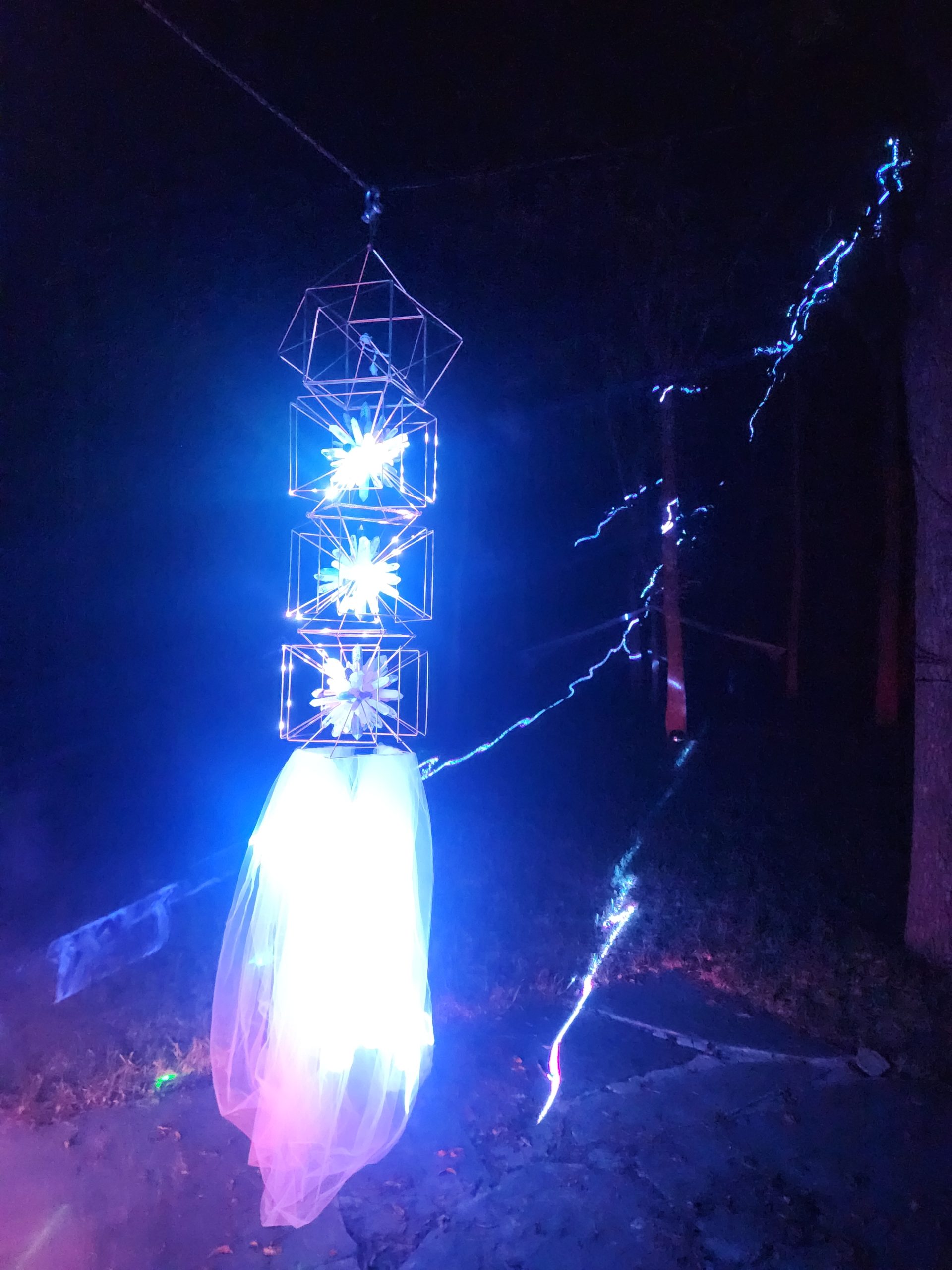
This compendium gathers peer-reviewed research on the aura, the light body, and the human biofield, then grades each finding on the MDH Evidence Gradient so that nothing is overstated.
It covers four questions: what the terms mean and where they come from; what the body measurably emits or radiates; what happens when people try to detect or influence a field; and what light itself is known to do in tissue. Each finding carries one epistemic marker.
| Tier | Evidence Gradient label | Used here for |
|---|---|---|
| Tier I | Established mechanisms | Replicated physical or physiological measurements |
| Tier II | Mixed evidence | Clinical outcomes with inconsistent or context-dependent results |
| Tier III | Theoretical biophysics | Plausible models not yet tested in the claimed setting |
| Tier IV | Experiential wellness art | Perceived, aesthetic, and symbolic dimensions |
Where this fits in the Library
All four of our aura-related pages place their core ideas at Tier IV and name the Evidence Gradient. The research below adds depth around that frame rather than moving the core claims up a tier.
| Page | What it covers |
|---|---|
| Crystallization of the Aura | Foundational concept; crystal as an image for attention settling into order; explicitly perceived, not physiological (Tier IV) |
| Structural Coherence | Coherence without (ordered light, crystal) and within (settling into attention); distinguishes physics coherence (Tier IV) |
| Auric Structuring (Library) | Four elements and the progression toward experiential becoming; Tier IV with a Tier III note on photobiomodulation dose |
| Auric Structuring sessions | Five elements including Aura & Attention and Resonant Field; color and spectrum |
Terminology and history
“Aura” and “light body” are tradition terms. “Biofield,” by contrast, is a research term coined in 1992, and the two should not be used as synonyms.
Key terms
Aura. In esoteric and devotional traditions, the aura is a luminous field around a person, often pictured as the halo of saints. Psychology, however, studies it as a reported perception, not as a measured field (see Response, below).
Light body. A contemplative and esoteric term for a subtle or radiant body. However, no research literature defines it operationally, so on MDH pages it belongs at Tier IV as tradition and symbol.
Biofield. The term was proposed in 1992 by an ad hoc committee convened by the NIH Office of Alternative Medicine, which defined it as “a massless field, not necessarily electromagnetic, that surrounds and permeates living bodies and affects the body” (Rubik et al., 2015, A Brief History of the Term Biofield section). The committee chose it to bridge traditional vital-energy terms (qi, ki, prana) and scientific vocabulary, and it later became a MeSH search term (Rubik et al., 2015).
Biofield physiology. Hammerschlag et al. (2015) narrow the idea to fields physiology already measures: the heart’s electrical and magnetic signals (ECG, MCG), the brain’s (EEG, MEG), steady bioelectric fields that guide wound repair, and ultraweak photon emission. As a result, this is the version of “biofield” that can be cited at Tier I, whereas the 1992 definition’s “not necessarily electromagnetic” field has no measurement behind it.
Timeline
| Year | Milestone | Why it matters |
|---|---|---|
| 2025 | Salari et al. image ultraweak light from living versus dead mice and from stressed plants | Newest imaging; light tracks vitality and stress |
| 2015 | Cifra et al. review finds no reliable evidence that biophotons are coherent | Controlling check on any “coherent light body” claim |
| 2015 | Rubik et al. and Hammerschlag et al. publish the biofield framework papers | Defines the research vocabulary |
| 2009 | Kobayashi et al. photograph the body’s own faint light across the day | The closest literal “light body” image science has |
| 1998 | Rosa et al. test whether Therapeutic Touch practitioners can sense a “human energy field” | The most cited detection test; result near chance |
| 1992 | NIH Office of Alternative Medicine committee coins “biofield” | The origin of the term used today in research. |
| 1968 | Cohen records the brain’s magnetic field outside the scalp | Body fields are real and extremely weak |
| 1963 | Baule and McFee report detecting the heart’s magnetic field | First magnetocardiogram |
| 1900s to 1950s | Gurwitsch proposes the morphogenetic field and reports “mitogenetic radiation” from dividing cells | Earliest scientific roots of light-from-life ideas (Rubik et al., 2015) |
| By 1850 | Electrophysiology replaces the vital force with measurable bioelectricity | Where the vital-energy idea left mainstream biology (Rubik et al., 2015) |
Measurement: what the body actually emits
The body does give off light and fields that instruments can record, but every one of them is invisible to the eye, and none has been shown to form the structured, colored aura described in tradition.
| Phenomenon | What is measured | Scale reported | Instrument | Tier |
|---|---|---|---|---|
| Ultraweak photon emission (biophotons) | Faint visible and near-visible light from oxidative metabolism | 10 to 1,000 photons per cm² per second (Salari et al., 2025); about 1,000 times below what the eye can see (Kobayashi et al., 2009) | Cooled CCD or EMCCD cameras, photomultipliers, total darkness | Tier I |
| Thermal infrared | Heat radiated by any warm body | Mostly above 1,000 nm, outside visible light (Salari et al., 2025) | Thermal cameras | Tier I |
| Heart’s electrical and magnetic signals | ECG at the skin; MCG outside the body | MCG first detected by Baule and McFee (1963) | ECG electrodes; magnetometers | Tier I |
| Brain’s magnetic field | MEG outside the scalp | About 1 × 10⁻⁹ gauss near the scalp, recorded only in a magnetically shielded chamber with signal averaging (Cohen, 1968) | SQUID-type magnetometers | Tier I |
| Steady bioelectric fields | Voltages across epithelia that steer wound repair | Described as a measured biofield by Hammerschlag et al. (2015) | Microelectrodes | Tier I |
The body’s own light
Tier I Kobayashi et al. (2009) imaged five healthy men in their 20s every three hours for three days in a dark room. Emission was weakest in the morning and then peaked near 16:00; at the cheek it reached about 3,000 photons per cm² per second, roughly double the 10:00 value. Emission correlated negatively with salivary cortisol (r = −0.31, p < .002), a small-to-moderate association, and did not track skin temperature. The authors attribute the light to reactive oxygen chemistry linked to the circadian clock; however, the sample is small and all male.
Tier I Salari et al. (2025) imaged clearly lower emission from mice after death than in life, and higher emission from plants when warmed or injured. They describe the method as offering “label-free imaging of vitality” (p. 4354).
Tier II Van Wijk et al. (2006) recorded 12 body sites in 20 healthy men and found lower emission in long-term Transcendental Meditation practitioners than in controls, which they read as reduced free radical activity. Because the study is cross-sectional, however, it cannot show that meditation caused the difference.
Tier ITier III Cifra et al. (2015) conclude that ultraweak emission is “experimentally well established,” but that “no reliable evidence for the coherence or nonclassicality” of this light has been achieved (p. 38). In short, the finding sits at Tier I and the coherence theory at Tier III. For that reason, we treat this review as the controlling citation on coherence.
Fields of the heart and brain
Tier I The brain’s magnetic field outside the scalp measured about 1 × 10⁻⁹ gauss and could be recorded only inside a multilayer shielded chamber with averaging (Cohen, 1968). Similarly, Baule and McFee (1963) reported the first detection of the heart’s magnetic field.
Moreover, body fields fall off steeply with distance and sit far below Earth’s magnetic field, so claims that a person’s field can be felt by another person across a room are not supported by these measurements.
Aura photography (Kirlian and GDV)
Tier I Pehek et al. (1976) found that Kirlian images “are principally a record of corona activity,” and that most variation in a living subject’s image “can be accounted for by the presence of moisture” (p. 263). Image size also depends on circuit resistance, and color shifts with moisture as well. In other words, the Tier I rating applies to the physics.
Tier III Kostyuk et al. (2011) present gas discharge visualization (GDV) as a promising biometric that reads “electrophotonic emissions of fingertips” (p. 1) and propose uses in autism and cancer screening. However, the paper is a proposal and summary of pilot work, not a validation study. Furthermore, GDV relies on the same gas-discharge principle that Pehek et al. analyzed, so moisture and electrical contact remain plausible confounds unless a study controls for them.
Response: perceiving, influencing, and settling the field
People report seeing and feeling auras, and some outcomes of hands-on or hands-near therapies beat placebo in small trials, yet no study has shown that a person can detect another person’s field under blinded conditions; the most defensible response evidence concerns the nervous system’s own settling.
Can people sense or see a field?
Tier I Rosa et al. (1998) asked 21 Therapeutic Touch practitioners, behind a screen, which of their hands the investigator’s hand hovered over. They were correct in 123 of 280 trials (44%), against 50% expected by chance, and experience did not predict accuracy (r = 0.23). Admittedly, the design tests detection only, not whether sessions help people, and the Tier I rating applies to it as a null result. Two coauthors were affiliated with skeptic organizations, which readers may weigh; the blinding and coin-flip randomization are stated in the paper.
Tier IV Milán et al. (2012) compared four synaesthetes who see colors in response to faces and figures with published descriptions of aura perception. Testing the proposal that aura reports reflect this kind of synaesthesia, they found the two “phenomenologically and behaviourally dissimilar” (p. 258), so synaesthesia does not simply explain aura reports.
Tier IV Among 212 adults recruited from a paranormal-interest mailing list, the 97 who reported seeing auras scored higher on anomalous experiences, transliminality, and “thin” boundaries than the 115 who did not; transliminality was the best predictor (Parra, 2015). Even so, the sample is self-selected and cross-sectional.
Tier IV After a short training session, 47 young adults reported novel experiences of an “aura-like phenomenon” around the hand and more positive thoughts (Jois et al., 2018). However, there was no control condition, so expectation and afterimage effects cannot be ruled out.
Taken together, these studies treat the aura as a perceptual and personal experience that varies across people. This fits the MDH framing of the aura as perceived coherence.
Biofield therapies (Reiki, Therapeutic Touch, Healing Touch)
Tier II Jain and Mills (2010) reviewed 66 clinical studies, most of medium quality. They rated the evidence as strong for reducing pain intensity in pain populations, moderate for pain in hospitalized and cancer patients, moderate for anxiety in hospitalized patients and for negative behavioral symptoms in dementia, and equivocal for fatigue and quality of life in cancer.
Tier II In 14 randomized placebo-controlled trials, Reiki outperformed placebo for clinically relevant stress and depression (GRADE high) and anxiety (moderate to high), but most trials carried “some concern” for bias and each outcome rested on few studies (Zadro & Stapleton, 2022).
Tier II Of 154 Reiki trials, only 35 (22%) used a sham Reiki group. Where the sham copied the Reiki protocol, 12 of 28 shams also improved outcomes, which the authors read as a placebo effect (Baldwin et al., 2026).
Tier II A 2026 meta-analysis of 15 surgical trials found moderate-to-low certainty evidence that Reiki reduced postoperative pain at 24 and 48 hours and anxiety, and its authors caution that placebo effects may contribute (Wang et al., 2026).
Overall, the pattern is consistent: modest benefits for pain and anxiety, mixed control quality, and real sham effects. That supports care, attention, and relaxation as active ingredients. Still, it does not establish that a field passes between people, which the Rosa et al. (1998) detection test also failed to show.
Coherence within: heart rhythm and the settling body
Tier ITier II Heart rate variability biofeedback trains slow breathing until heart rate rises and falls in a smooth, sine-like wave. Lehrer and Gevirtz (2014) report this pattern “occurs in almost everyone” (Mechanisms by Which High-Amplitudes of HRV Are Achieved section), often within a fraction of a minute, and name baroreflex strengthening as the best-supported mechanism. In this case, the physiology sits at Tier I, while outcomes sit at Tier II.
Tier III McCraty and Zayas (2014), writing from the HeartMath Institute in a hypothesis and theory article, define cardiac coherence as “the order, stability, and harmony in the oscillatory outputs of the regulatory systems” (Introduction section) and propose that positive emotion produces this sine-wave heart rhythm. This is a model; nevertheless, it is the closest scientific use of “coherence” to the MDH sense of coherence within.
Tier II In a pilot randomized trial with 39 healthy young adults, 30 minutes in a dim sensory room with cushions and aroma oils raised respiratory sinus arrhythmia, a vagal marker, compared with handicrafts and puzzles; mood and attention did not differ between groups (Otsuka et al., 2025). In their Bayesian analysis, resting RSA rose after the sensory room (difference 0.52, 95% credible interval 0.23 to 0.82), while it tended to fall after the comparison activities.
Tier II Immersive awe videos raised self-reported awe and presence over flat-screen viewing in 42 adults, and awe content produced higher parasympathetic activation (Chirico et al., 2017). Similarly, a campus immersive art exhibit was followed by better mood scores, although there was no comparison group (Godley et al., 2025).
Light and the body
Applied light acts on tissue through absorption and dose, not through the aura. For this reason, this section covers only the points where light research touches the aura.
Two directions of light. The body’s own light (ultraweak emission, thermal infrared) flows outward and is far too faint to see. In contrast, applied light in an Auric Structuring room flows inward and acts only where it is absorbed. Keeping the two apart prevents the common slide from “the body emits light” to “light restores the body’s light.”
Tier ITier III Low-level light effects follow a biphasic dose response, in which lower doses often stimulate more than higher ones, and outcomes depend on wavelength, irradiance, pulse structure, and time (Huang et al., 2009). The authors also note that polarized light “is rapidly scrambled” in tissue, “probably in the first few hundred μm” (Table 1). Therefore, the mechanism sits at Tier I, while its effect inside an installation sits at Tier III. Meanwhile, the ordered quality of laser light in a Portal of Light is an optical and visual property of the room, which supports describing coherence without as something seen rather than something absorbed. This also matches the Tier III note on our Auric Structuring Library page that any photobiomodulation effect “depends on a dose that has not been measured there.”
By comparison, light that reaches the eyes acts through the visual and non-visual retinal pathways, and immersive light that invites slow attention fits the soft-fascination and awe evidence. These are the honest bridges between light and the felt sense of an ordered aura.
Evidence table
Twenty-four sources are cited here. As of 9 October 2026, Crossref lists no retraction, correction, or expression of concern for any of them. The first columns give what the authors reported; the Evaluation and Tier columns give our assessment.
| Source | Design and sample | Authors report | Evaluation | Tier |
|---|---|---|---|---|
| Rubik et al., 2015 | Conceptual review | Origin and definition of “biofield” (1992, NIH) | Reliable history; proponent authors | Tier I |
| Hammerschlag et al., 2015 | Conceptual review | ECG, MCG, EEG, MEG, wound fields, and UPE as “biofields”; calls UPE coherent | Measured fields well supported; coherence claim conflicts with Cifra et al. (2015) | Tier ITier III |
| Kobayashi et al., 2009 | Imaging, 5 men, 3 days | Body light peaks near 16:00; inverse with cortisol | Small sample; strong method | Tier I |
| Salari et al., 2025 | Imaging, mice and plants | Living vs dead contrast; stress raises UPE | Newest imaging; no human data | Tier I |
| Cifra et al., 2015 | Critical review | UPE established; coherence unproven | Controlling check on coherence claims | Tier ITier III |
| Van Wijk et al., 2006 | Cross-sectional, 20 men | Lower UPE in long-term meditators | Association only | Tier II |
| Cohen, 1968 | Physiological measurement | Brain field about 1 × 10⁻⁹ gauss, shielded room | Shows how faint body fields are | Tier I |
| Baule & McFee, 1963 | Physiological measurement | First magnetocardiogram | Historical first detection | Tier I |
| Pehek et al., 1976 | Laboratory physics | Kirlian images reflect corona and moisture | Undercuts aura photography | Tier I |
| Kostyuk et al., 2011 | Position paper, pilot summary | GDV as medical biometric | Not a validation study | Tier III |
| Rosa et al., 1998 | Blinded detection test, 21 practitioners, 280 trials | 44% correct vs 50% chance | Tests detection, not outcomes; authors from skeptic groups | Tier I as null result |
| Milán et al., 2012 | Case comparison, 4 synaesthetes | Aura reports differ from synaesthesia | Very small sample | Tier IV |
| Parra, 2015 | Survey, 212 adults | Aura perceivers higher in transliminality | Self-selected sample | Tier IV |
| Jois et al., 2018 | Pre-post, 47 students | Trained viewers report aura-like effects | No control; expectation likely | Tier IV |
| Jain & Mills, 2010 | Best evidence synthesis, 66 studies | Strong for pain intensity; moderate for anxiety | Older; medium-quality studies | Tier II |
| Zadro & Stapleton, 2022 | Systematic review, 14 placebo RCTs | Reiki beats placebo for clinical stress, depression | Few trials per outcome; bias concerns | Tier II |
| Baldwin et al., 2026 | Scoping review, 35 sham-controlled trials | Shams often improve outcomes | Placebo is substantial | Tier II |
| Wang et al., 2026 | Meta-analysis, 15 RCTs | Less postoperative pain and anxiety | Moderate-to-low certainty | Tier II |
| Lehrer & Gevirtz, 2014 | Mechanism review | HRV biofeedback works via baroreflex | Well supported physiology | Tier I |
| McCraty & Zayas, 2014 | Hypothesis and theory | Cardiac coherence model | Model from the HeartMath Institute; not an outcome study | Tier III |
| Otsuka et al., 2025 | Pilot RCT, 39 adults | Sensory room raised RSA; mood unchanged | Pilot | Tier II |
| Chirico et al., 2017 | Experiment, 42 adults | Immersion raised awe; awe raised parasympathetic activity | Lab video, not installation | Tier II |
| Godley et al., 2025 | Pre-post, campus exhibit | Mood improved after visit | No comparison group | Tier IV |
| Huang et al., 2009 | Narrative review | Biphasic dose response; polarization scrambled in tissue | Mechanism, not installation data | Tier ITier III |
Synthesis
The research supports a body that glows faintly and hums with weak fields, and a nervous system that measurably settles in calm, beautiful, attentive settings; it does not support an aura that others can see or touch, so our word “perceived” is the accurate one.
Patterns
- Measurement is strong where it is physical. Body light, heart and brain fields, and wound fields are measured in the lab (Tier I), but each is invisible and very faint.
- Detection fails under blinding. The one well-known blinded test of sensing another person’s field was at chance (Rosa et al., 1998). Aura perception research treats the aura as a personal experience linked to traits such as transliminality (Parra, 2015).
- Outcomes outrun mechanism. Biofield therapies show modest gains for pain and anxiety, and sham versions often help too (Baldwin et al., 2026). In short, the benefit is real, but the proposed mechanism is unshown.
- Coherence within is measurable. Heart rhythm becomes smooth and sine-like with slow breathing (Lehrer & Gevirtz, 2014), and a dim, soft sensory room raised a vagal marker in a pilot trial (Otsuka et al., 2025).
Disagreements to keep visible
- Is body light coherent? Hammerschlag et al. (2015) describe UPE as coherent; Cifra et al. (2015) find no reliable evidence that it is. This compendium follows Cifra et al.
- What does a sham effect mean? Proponents read positive placebo-controlled Reiki trials as specific effects (Zadro & Stapleton, 2022); Baldwin et al. (2026) show shams that copy the protocol often improve outcomes too. Both readings remain open.
- What does “coherence” mean? Physics coherence (waves in step), cardiac coherence (a smooth heart rhythm), and Auric Structuring coherence (a felt sense of order) are three different things, and they are easy to blur.
Gaps that matter
- No installation data. We found no study that measures body light, heart rhythm, or reported aura perception inside an immersive light-and-crystal environment. This matters because we move a claim up a tier only when data from MDH events supports it. Any physiological or survey data collected from visitors would go through documented ethical review first.
- Aura perception is barely studied. The studies we found have 4 to 212 participants, mostly self-selected, and none uses a blinded or controlled design.
- Sham design is the bottleneck. Only 22% of Reiki trials used a sham group (Baldwin et al., 2026), so the field cannot yet separate specific from general effects.
Contribution type
Crystallization of the Aura, as written, is a new conceptual synthesis: it joins aura tradition, ordered light and crystal, and research on physiological settling under the word “perceived.” Measuring heart rhythm or self-reported coherence in a Portal of Light would turn it toward a new empirical finding.
The research behind this articleSources
Show sourcesHide sources
- Baldwin, A. L., DeLeon, P., & Dyer, N. L. (2026). Investigation and assessment of sham Reiki protocols in Reiki research. Complementary Therapies in Medicine, 101, Article 103415. https://doi.org/10.1016/j.ctim.2026.103415
- Baule, G. M., & McFee, R. (1963). Detection of the magnetic field of the heart. American Heart Journal, 66(1), 95–96. https://doi.org/10.1016/0002-8703(63)90075-9
- Chirico, A., Cipresso, P., Yaden, D. B., Biassoni, F., Riva, G., & Gaggioli, A. (2017). Effectiveness of immersive videos in inducing awe: An experimental study. Scientific Reports, 7(1), Article 1218. https://doi.org/10.1038/s41598-017-01242-0
- Cifra, M., Brouder, C., Nerudová, M., & Kučera, O. (2015). Biophotons, coherence and photocount statistics: A critical review. Journal of Luminescence, 164, 38–51. https://doi.org/10.1016/j.jlumin.2015.03.020
- Cohen, D. (1968). Magnetoencephalography: Evidence of magnetic fields produced by alpha-rhythm currents. Science, 161(3843), 784–786. https://doi.org/10.1126/science.161.3843.784
- Godley, L., O’Hayer, C. V., Davis, R., Wakschal, E., Nurse, C., Ross, W., Spraker, A., Godshall, N., & Frasso, R. (2025). “University stress” exploring the potential impact of an immersive art experience on a college campus. Frontiers in Psychology, 16, Article 1592649. https://doi.org/10.3389/fpsyg.2025.1592649
- Hammerschlag, R., Levin, M., McCraty, R., Bat, N., Ives, J. A., Lutgendorf, S. K., & Oschman, J. L. (2015). Biofield physiology: A framework for an emerging discipline. Global Advances in Health and Medicine, 4(Suppl), 35–41. https://doi.org/10.7453/gahmj.2015.015.suppl
- Huang, Y.-Y., Chen, A. C.-H., Carroll, J. D., & Hamblin, M. R. (2009). Biphasic dose response in low level light therapy. Dose-Response, 7(4), 358–383. https://doi.org/10.2203/dose-response.09-027.Hamblin
- Jain, S., & Mills, P. J. (2010). Biofield therapies: Helpful or full of hype? A best evidence synthesis. International Journal of Behavioral Medicine, 17(1), 1–16. https://doi.org/10.1007/s12529-009-9062-4
- Jois, S. N., Nagaraj, S. S., Prasad, K. N., & D’Souza, L. (2018). Training in aura reading: Results from a small quasi-experimental study in India (research note). International Journal of Transpersonal Studies, 37(2). https://doi.org/10.24972/ijts.2018.37.2.171
- Kobayashi, M., Kikuchi, D., & Okamura, H. (2009). Imaging of ultraweak spontaneous photon emission from human body displaying diurnal rhythm. PLoS ONE, 4(7), Article e6256. https://doi.org/10.1371/journal.pone.0006256
- Kostyuk, N., Cole, P., Meghanathan, N., Isokpehi, R. D., & Cohly, H. (2011). Gas discharge visualization: An imaging and modeling tool for medical biometrics. International Journal of Biomedical Imaging, 2011, Article 196460. https://doi.org/10.1155/2011/196460
- Lehrer, P. M., & Gevirtz, R. (2014). Heart rate variability biofeedback: How and why does it work? Frontiers in Psychology, 5, Article 756. https://doi.org/10.3389/fpsyg.2014.00756
- McCraty, R., & Zayas, M. A. (2014). Cardiac coherence, self-regulation, autonomic stability, and psychosocial well-being. Frontiers in Psychology, 5, Article 1090. https://doi.org/10.3389/fpsyg.2014.01090
- Milán, E. G., Iborra, O., Hochel, M., Rodríguez-Artacho, M., Delgado-Pastor, L. C., Salazar, E., & González-Hernández, A. (2012). Auras in mysticism and synaesthesia: A comparison. Consciousness and Cognition, 21(1), 258–268. https://doi.org/10.1016/j.concog.2011.11.010
- Otsuka, H., Irie, K., Kogata, T., Onitsuka, A., & Inadomi, H. (2025). Effects of sensory room intervention on autonomic function in healthy adults: A pilot randomized controlled trial. PLoS ONE, 20(4), Article e0319649. https://doi.org/10.1371/journal.pone.0319649
- Parra, A. (2015). Experiencias perceptuales inusuales en el constructo de límite “fino”: Su relación con la esquizotipia. Revista Mexicana de Investigación en Psicología, 7(1), 43–51. https://doi.org/10.32870/rmip.vi.564
- Pehek, J. O., Kyler, H. J., & Faust, D. L. (1976). Image modulation in corona discharge photography. Science, 194(4262), 263–270. https://doi.org/10.1126/science.968480
- Rosa, L., Rosa, E., Sarner, L., & Barrett, S. (1998). A close look at therapeutic touch. JAMA, 279(13), 1005–1010. https://doi.org/10.1001/jama.279.13.1005
- Rubik, B., Muehsam, D., Hammerschlag, R., & Jain, S. (2015). Biofield science and healing: History, terminology, and concepts. Global Advances in Health and Medicine, 4(Suppl), 8–14. https://doi.org/10.7453/gahmj.2015.038.suppl
- Salari, V., Seshan, V., Frankle, L., England, D., Simon, C., & Oblak, D. (2025). Imaging ultraweak photon emission from living and dead mice and from plants under stress. The Journal of Physical Chemistry Letters, 16(17), 4354–4362. https://doi.org/10.1021/acs.jpclett.4c03546
- Van Wijk, E. P. A., Koch, H., Bosman, S., & Van Wijk, R. (2006). Anatomic characterization of human ultra-weak photon emission in practitioners of Transcendental Meditation and control subjects. The Journal of Alternative and Complementary Medicine, 12(1), 31–38. https://doi.org/10.1089/acm.2006.12.31
- Wang, H., Ma, Q., Wang, L., & Chen, F. (2026). The effectiveness of Reiki in surgical care: A systematic review and meta-analysis. Intensive and Critical Care Nursing, 98, Article 104560. https://doi.org/10.1016/j.iccn.2026.104560
- Zadro, S., & Stapleton, P. (2022). Does Reiki benefit mental health symptoms above placebo? Frontiers in Psychology, 13, Article 897312. https://doi.org/10.3389/fpsyg.2022.897312
Book a personalized session in the Ozarks, or bring the full experience to your festival, retreat, or event.

Founder of Mountain's Daughter Health and creator of Auric Structuring™. A mixed media artist, scholar practitioner, and wellness innovator rooted in the Ozark Mountains.
These services are not intended to diagnose, treat, cure, or prevent any disease. Mountain's Daughter Health provides wellness services and experiential wellness programming only. Consult your healthcare provider before beginning any new wellness program, especially if pregnant, nursing, or managing a chronic condition.
From the Journal
Keep reading
Photobiomodulation and Red Light Therapy: The Evidence
A closer look at the first of the Three Signals: what red light actually does in the body, where the research is strong, where…
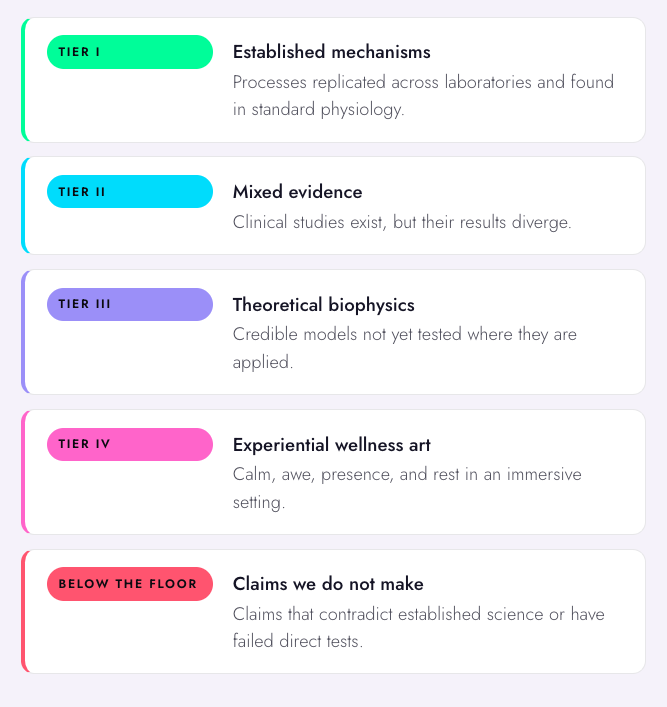
The Evidence Gradient
An original Mountain's Daughter Health framework for matching the strength of a wellness claim to the evidence behind it Practices built on light, field,…
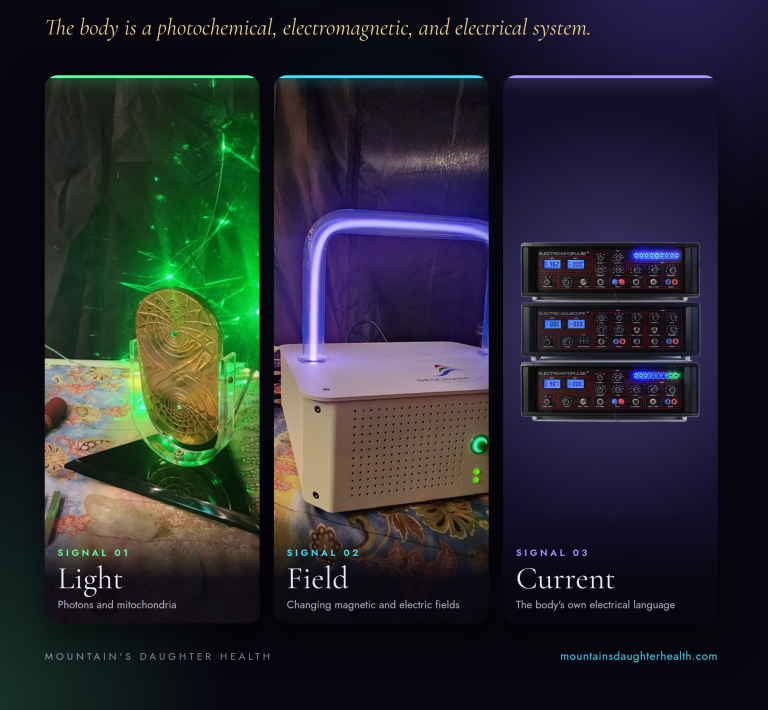
One Body, Three Signals
How I think about light, field, and current in wellness, and why I am careful about what I claim A good Ozark farmer does…