
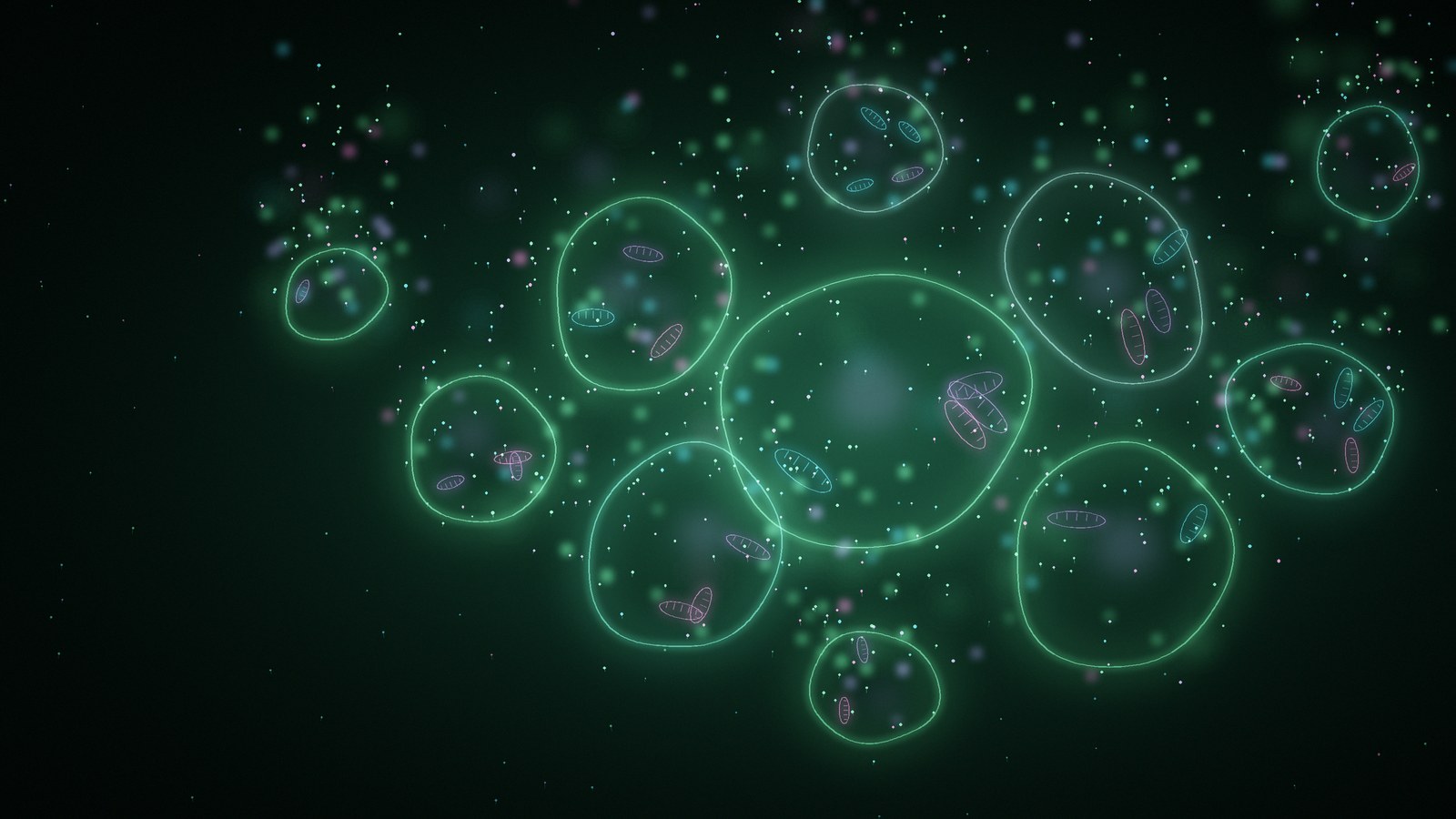
Seal a room against every trace of light, sit in it until your eyes have fully adjusted, and hold up your hand. You will see nothing. Yet your hand is shining. Every living cell in it is giving off a light so faint that it takes a photomultiplier tube, a detector built to count single particles of light, to register it.
Scientists call this light ultraweak photon emission. Most of us know it as biophotons. It spans roughly 200 to 800 nanometers, from ultraviolet through visible light, and it amounts to only a few to several hundred photons per second from each square centimeter of tissue (Mould et al., 2024). It has been recorded from people, plants, seeds, fungi, and foods. It is real, and it is measurable.
It also helps to know what biophotons are not. They are not bioluminescence, the bright, enzyme-made glow of fireflies and luminous bacteria (Kobayashi et al., 2014). Researchers also separate spontaneous biophotons from delayed luminescence, the faint afterglow a living sample gives off after it has been lit. Some of the earliest and most famous biophoton work did not tell those two apart (Mould et al., 2024), which is one reason older claims about the “light” in food deserve a careful second look.
The more interesting question is what it is telling us.
Sparks From the Fire
Picture a campfire. The fire is the work: wood becoming heat. When a log shifts, sparks fly up, and the more fiercely the fire burns, the more sparks you see. The sparks are not the point of the fire, but they tell you a great deal about it.
Biophotons are the sparks of cellular life. Our cells burn fuel in their mitochondria, and that work produces reactive oxygen species as a byproduct. When those reactive molecules damage fats in cell membranes (a process called lipid peroxidation), they leave molecules in briefly excited, high-energy states. As those molecules settle back down, some of them release a photon (Mould et al., 2024).
Healthy cells keep those reactive molecules in check with antioxidant defenses, from enzymes to vitamins C and E, which is why the light stays so faint most of the time. When stress outpaces those defenses, the reactive molecules build up and the light grows stronger (Kobayashi et al., 2014).
Stress makes the fire throw more sparks. When azuki bean seedlings were heated quickly, their light emission rose in both rate and intensity; seedlings first given a milder heat exposure responded less to a later, hotter one (Kobayashi et al., 2014). As well, in yeast cells grown on different amounts of sugar, the faint afterglow the cells gave off after being lit tracked how well their mitochondria were working (Tian et al., 2022).
Biophotons, then, are an optical readout of oxidative stress and mitochondrial activity. The light is chemistry made visible.
What Biophotons Can and Cannot Tell Us
Your body does not glow evenly. In early measurements of two people, the forehead and hands gave off noticeably more light than flatter areas such as the abdomen, back, and chest (Van Wijk & Van Wijk, 2005). It is a small, early observation, but it hints that each part of the body keeps its own light signature.
More light is not always worse. It is tempting to assume a calmer, healthier body simply glows less. Sometimes it does. When the skin of 25 women was exposed to ultraviolet light, its emission rose, and a cream containing oligomeric proanthocyanidins (plant polyphenols found in foods such as cacao and grape seed) reduced that UV-driven light by about 30% (Van Wijk et al., 2010). Yet living, growing things also shine more: viable soybean seeds emit roughly twice the light of seeds that can no longer sprout, and germinating mung beans emit more as they grow (Mould et al., 2024). Light reflects activity as well as stress. Which one you are seeing depends on the tissue and the comparison.
The mind seems to matter, in small studies. Researchers have measured biophotons before and after meditation and energy healing. In five meditators, one person with high starting values showed a clear and lasting drop, while the others changed only slightly (Van Wijk & Van Wijk, 2005). In a set of pilot studies, emission from energy healers’ palms fell about 11% after sessions, while practitioners deliberately focusing their intention emitted more light from specific parts of the body (Rubik & Jabs, 2017). These are early, very small studies, and the changes run in both directions. They invite further research rather than settle anything.
Left and right, in balance. Traditional Chinese and Korean medicine read illness partly as an imbalance between the two sides of the body. In one Korean study of seven people recovering from one-sided paralysis, four showed unusually large differences between the light from their left and right hands; after acupuncture, those differences were reported to even out (Van Wijk & Van Wijk, 2005). With only seven people and no comparison group, it is a promising observation in one group of patients, not a proven effect of acupuncture.
Biophotons are not yet a medical test. Because emission tracks oxidative stress, researchers are exploring it as a noninvasive marker, but no trials yet show it outperforms existing diagnostic tools (Mould et al., 2024).
Even so, the research is moving. The oxidative light that accompanies disease has been detected in acute myeloid leukemia, in cardiovascular disease, and in a mouse model of rheumatoid arthritis (Mould et al., 2024). Biophotons today are a research instrument with real promise, not a clinic test.
The “coherent light” idea remains unproven. You may have read that biophotons are laser-like light that cells use to communicate. A careful review of the evidence concluded that biophoton emission is well established, but that no reliable evidence yet shows it to be coherent (Cifra et al., 2015). It is a fascinating hypothesis. It is not a finding.
The question is still being asked well. When one team studied the light from germinating seeds, they found a complex, structured pattern in the signal that was absent from the detector’s own background noise, and they offered quantum coherence as one possible explanation among several (Benfatto et al., 2021). The frontier is open. It is simply not settled.
Plants, Herbs, and the Light of Quality
Plants tell the same story. Their emission rises when they are wounded or stressed by salt and drought (Mould et al., 2024). In stored seeds of five legume species, light measurements helped predict which seeds would still germinate, although the relationship differed from species to species (Griffo et al., 2024). In fresh medicinal roots, light emission shifted with the plant’s age and variety and moved in step with its active compounds (Zhao et al., 2017), and the afterglow of dried herbs could tell raw material from processed material (Sun et al., 2018).
The details are striking. Two-year-old balloon flower roots (Platycodon grandiflorum) gave off significantly more light than one-year-old roots and held more of the saponins that define their quality. In red sage (Salvia miltiorrhiza), light and active compounds rose together with age in one variety and fell together in another (Zhao et al., 2017). In processed herbs, the afterglow stopped changing after four rounds of processing, matching what chemical analysis had already shown (Sun et al., 2018). Here, the brighter root was the more potent one.
Food has a longer and more tangled history. Fritz-Albert Popp, a pioneer of the field, used light to tell conventionally grown tomatoes from supermarket ones, and later researchers have applied light measurements to egg quality, tomato ripeness, fertilizers, and farming styles (Mould et al., 2024). Because Popp’s methods did not separate spontaneous light from afterglow (Mould et al., 2024), this work does not show that organic food “carries more light.” What it does show is that light can register differences in how food is grown and handled.
For a company that wildcrafts and makes everything in small batches, that is a meaningful direction: one day, light itself may help confirm how fresh and well handled a root or mushroom really is. For now, these are research tools, and no one has yet measured the light of lion’s mane, reishi, chaga, or turkey tail.
Why This Matters to Our Work
At Mountain’s Daughter Health, our light sessions (photobiomodulation, PEMF, microcurrent, and Auric Structuring) are designed around cellular and mitochondrial function, and our botanical formulas are built from plants studied for their antioxidant and protective chemistry. Biophoton research sits right at that meeting point: it is the light cells give off as they handle oxidative load.
We want to help you consume and become LIGHT!
Here is what that looks like in the research. Every plant in our formulas was built from sunlight through photosynthesis. Mushrooms take it a step further: ultraviolet light turns the ergosterol in a mushroom into vitamin D2, and UV-exposed mushrooms eaten fresh can carry more than 10 micrograms per 100 grams, close to the daily intake recommended internationally (Cardwell et al., 2018). As well, many of the botanicals we work with, from cacao to hawthorn, are rich in the same polyphenol family that quieted UV-driven light from skin in the study above (Van Wijk et al., 2010). Light builds the plant. The plant, in turn, helps the body manage the very chemistry that makes our cells glow.
That also shapes how we think about Photic Lustration. Our installations use structured light to reach the nervous system through the eyes, while each person in the space is quietly emitting light of their own. If an immersive environment helps the body settle, would that inner light shift too? It is a question worth testing carefully. We hold it as a working idea, not a promise.
The research already supplies the pieces. Emission tracks oxidative status (Mould et al., 2024), an antioxidant reduced UV-driven emission from skin (Van Wijk et al., 2010), and small studies report changes with meditation and intention, in both directions (Rubik & Jabs, 2017; Van Wijk & Van Wijk, 2005). A careful study would measure the light from a person’s hands, including its left-right balance, in complete darkness before and after time in the space, with proper ethical review in place before anyone takes part. No one has run that study yet. We would love to help.
An Honest Light
The most remarkable thing about biophotons needs no exaggeration. Every cell you have is keeping a faint record, written in light, of how it is handling the work of being alive. Learning to read that record well is the invitation.
The research behind this articleSources
Show sourcesHide sources
- Benfatto, M., Pace, E., Curceanu, C., Scordo, A., Clozza, A., Davoli, I., Lucci, M., Francini, R., De Matteis, F., Grandi, M., Tuladhar, R., & Grigolini, P. (2021). Biophotons and emergence of quantum coherence: A diffusion entropy analysis. Entropy, 23(5), Article 554. https://doi.org/10.3390/e23050554
- Cardwell, G., Bornman, J. F., James, A. P., & Black, L. J. (2018). A review of mushrooms as a potential source of dietary vitamin D. Nutrients, 10(10), Article 1498. https://doi.org/10.3390/nu10101498
- Cifra, M., Brouder, C., Nerudová, M., & Kučera, O. (2015). Biophotons, coherence and photocount statistics: A critical review. Journal of Luminescence, 164, 38–51. https://doi.org/10.1016/j.jlumin.2015.03.020
- Griffo, A., Sehmisch, S., Laager, F., Pagano, A., Balestrazzi, A., Macovei, A., & Börner, A. (2024). Non-invasive methods to assess seed quality based on ultra-weak photon emission and delayed luminescence. Scientific Reports, 14, Article 26838. https://doi.org/10.1038/s41598-024-74207-9
- Kobayashi, K., Okabe, H., Kawano, S., Hidaka, Y., & Hara, K. (2014). Biophoton emission induced by heat shock. PLoS ONE, 9(8), Article e105700. https://doi.org/10.1371/journal.pone.0105700
- Mould, R. R., Mackenzie, A. M., Kalampouka, I., Nunn, A. V. W., Thomas, E. L., Bell, J. D., & Botchway, S. W. (2024). Ultra weak photon emission: A brief review. Frontiers in Physiology, 15, Article 1348915. https://doi.org/10.3389/fphys.2024.1348915
- Rubik, B., & Jabs, H. (2017). Effects of intention, energy healing, and mind-body states on biophoton emission. Cosmos and History: The Journal of Natural and Social Philosophy, 13(2), 227–247. https://cosmosandhistory.org/index.php/journal/article/view/608
- Sun, M., Chang, W.-T., Van Wijk, E., He, M., Van Wijk, R., & Wang, M. (2018). Application of delayed luminescence method on measuring of the processing of Chinese herbal materials. Chinese Medicine, 13, Article 43. https://doi.org/10.1186/s13020-018-0202-0
- Tian, M., Li, Q., Liu, Y., Zheng, P., Li, D., Zhao, Y., Wang, B., Li, C., Wang, J., Gao, P., Tang, Q., Zhang, X., & Wu, H. (2022). Relationship between delayed luminescence emission and mitochondrial status in Saccharomyces cerevisiae. Scientific Reports, 12, Article 394. https://doi.org/10.1038/s41598-021-04290-9
- Van Wijk, E. P. A., Van Wijk, R., & Bosman, S. (2010). Using ultra-weak photon emission to determine the effect of oligomeric proanthocyanidins on oxidative stress of human skin. Journal of Photochemistry and Photobiology B: Biology, 98(3), 199–206. https://doi.org/10.1016/j.jphotobiol.2010.01.003
- Van Wijk, R., & Van Wijk, E. P. A. (2005). An introduction to human biophoton emission. Forschende Komplementärmedizin und Klassische Naturheilkunde, 12(2), 77–83. https://doi.org/10.1159/000083763
- Zhao, X., Pang, J., Fu, J., Yang, M., Van Wijk, E., Liu, Y., Fan, H., Zhang, Y., & Han, J. (2017). Application of spontaneous photon emission in the growth ages and varieties screening of fresh Chinese herbal medicines. Evidence-Based Complementary and Alternative Medicine, 2017, Article 2058120. https://doi.org/10.1155/2017/2058120
Book a personalized session in the Ozarks, or bring the full experience to your festival, retreat, or event.
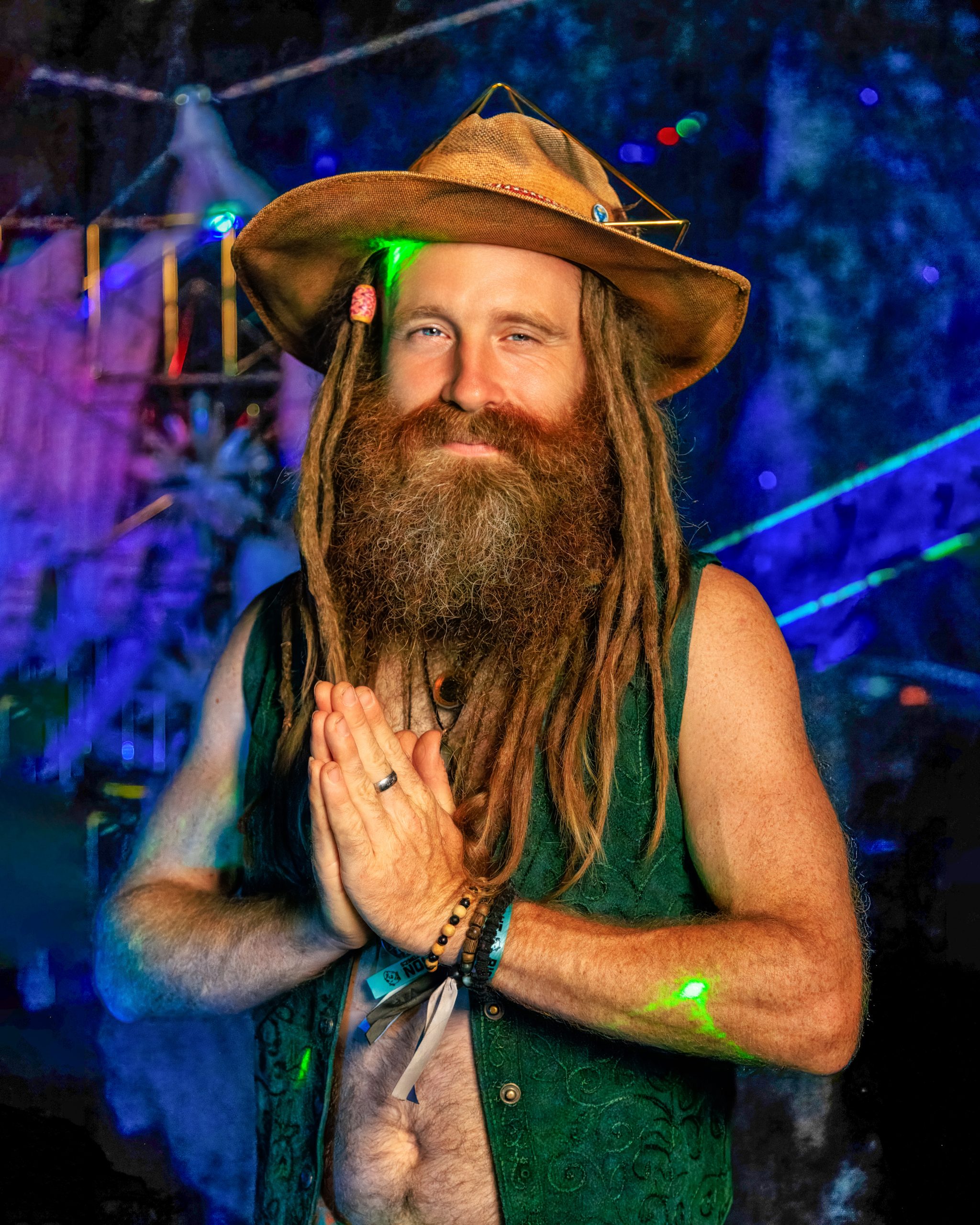
Founder of Mountain's Daughter Health and creator of Auric Structuring™. A mixed media artist, scholar practitioner, and wellness innovator rooted in the Ozark Mountains.
These services are not intended to diagnose, treat, cure, or prevent any disease. Mountain's Daughter Health provides wellness services and experiential wellness programming only. Consult your healthcare provider before beginning any new wellness program, especially if pregnant, nursing, or managing a chronic condition.
From the Journal
Keep reading
Aura, Light Body and Biofield
This compendium gathers peer-reviewed research on the aura, the light body, and the human biofield, then grades each finding on the MDH Evidence Gradient…
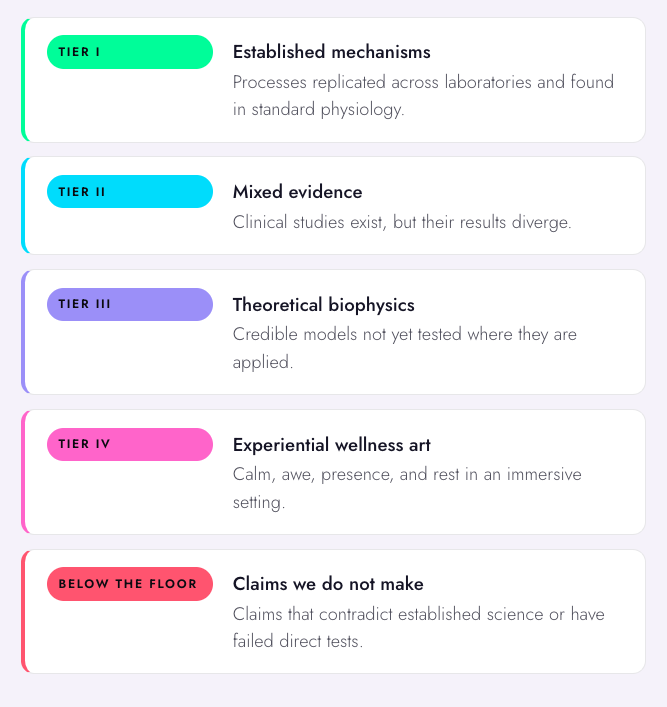
The Evidence Gradient
An original Mountain's Daughter Health framework for matching the strength of a wellness claim to the evidence behind it Practices built on light, field,…
Photobiomodulation and Red Light Therapy: The Evidence
A closer look at the first of the Three Signals: what red light actually does in the body, where the research is strong, where…