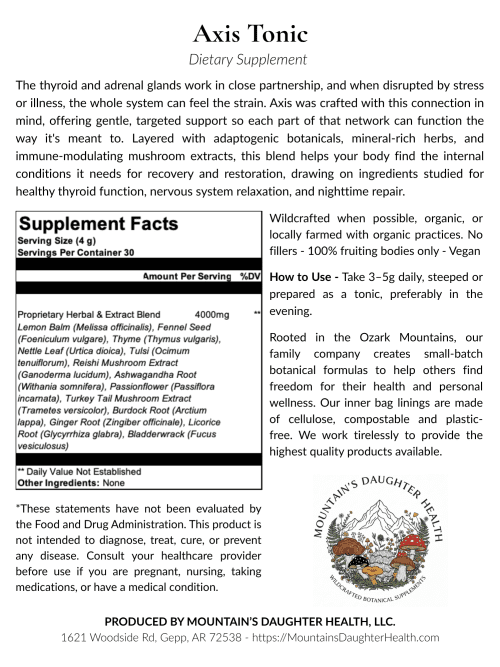
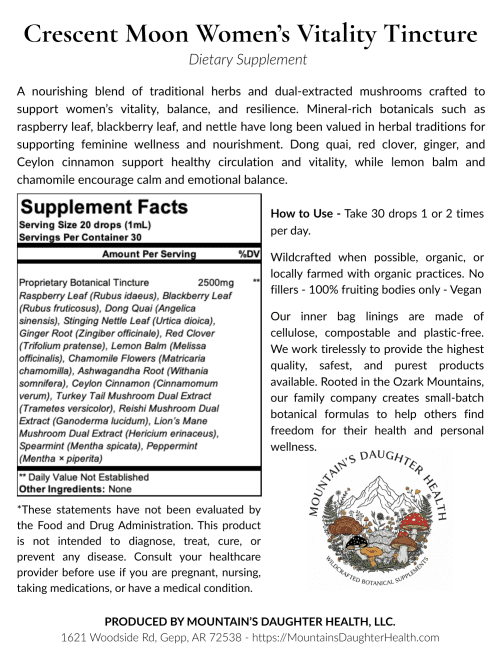
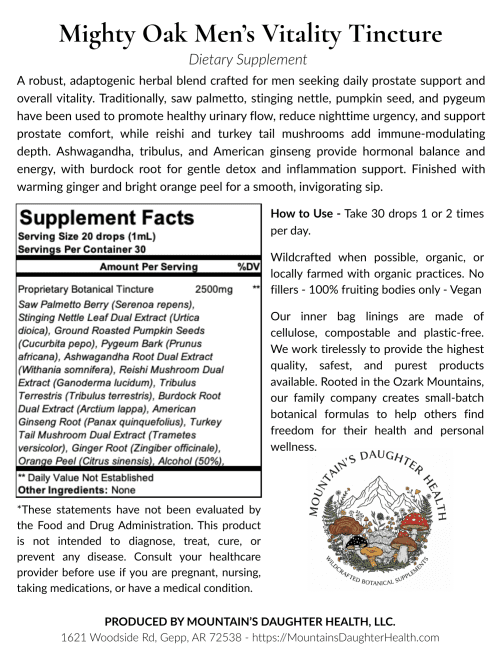
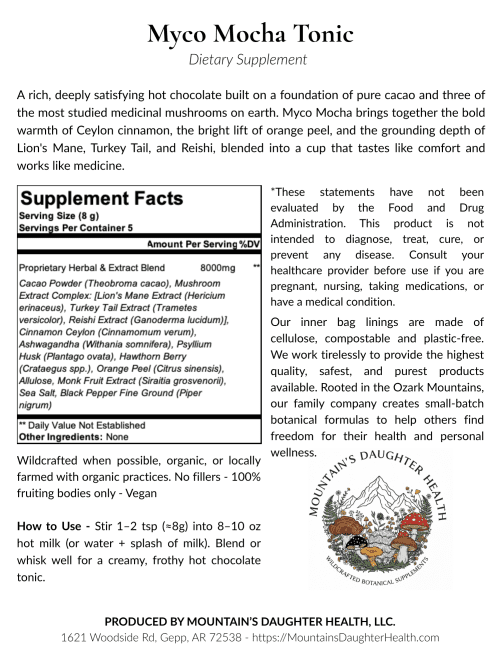
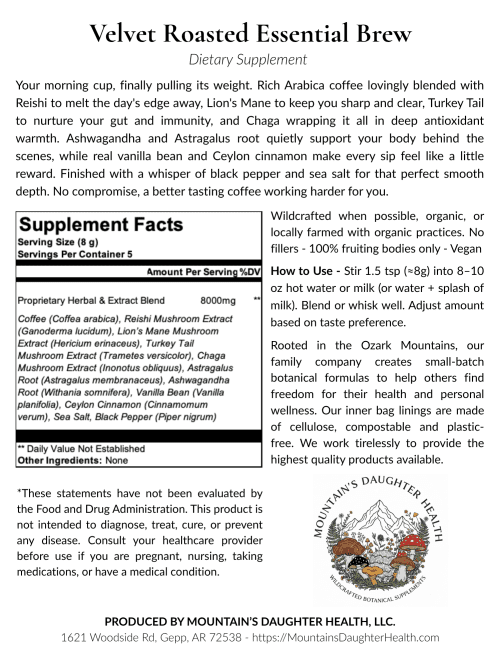
Ashwagandha (Withania somnifera) is a small shrub of the nightshade family, native to India, whose root has been used for centuries in Ayurveda as a rasayana, a rejuvenating tonic, and to strengthen the nervous system (Mikulska et al., 2023). Today it is one of the most popular herbs sold as an adaptogen, and it appears in more of our blends than any other herb. That is exactly why it deserves a careful look: what the studies show, what they do not, and who should be cautious.
What Is in the Root
The root is the part used in medicine. The compounds most often credited with its effects are withanolides, a family of steroid-like molecules, along with alkaloids (Mikulska et al., 2023). Commercial extracts are usually standardized to a stated withanolide content, and the trials below mostly used branded root extracts rather than plain powdered root. Results from one extract do not automatically apply to another, or to the root as it appears in a tea or tonic.
What the Evidence Shows
Stress and anxiety. In a 60-day trial of 64 adults with chronic stress, 300 mg of a root extract twice daily lowered scores on every stress scale used and reduced serum cortisol compared with placebo (Chandrasekhar et al., 2012). A second 60-day trial in 60 stressed adults found a lower anxiety score and lower morning cortisol with 240 mg a day, though a broader stress, anxiety, and depression score did not reach significance (Lopresti, Smith, et al., 2019). A 2022 meta-analysis of 12 trials with 1,002 participants found reductions in both anxiety and stress, but the trials varied so much that the authors rated the certainty of the evidence as low and called for higher-quality studies (Akhgarjand et al., 2022). A 2024 meta-analysis of nine trials with 558 people found modest drops in perceived stress, anxiety ratings, and blood cortisol (Arumugam et al., 2024), and a systematic review of nine trials in stressed adults noted that none had examined long-term effects on the adrenal glands (Della Porta et al., 2023).
Sleep. A 2021 meta-analysis of five trials with 400 participants found a small but significant improvement in overall sleep. The effect was larger in adults diagnosed with insomnia, at doses of at least 600 mg a day, and over at least 8 weeks. The authors noted that data on serious side effects were limited, especially for long-term use (Cheah et al., 2021).
Thyroid. In a pilot trial of 50 adults with subclinical hypothyroidism, 600 mg of root extract a day for 8 weeks moved TSH, T3, and T4 toward normal compared with placebo (Sharma et al., 2018). It was small and short, but it matters for safety as well as benefit: an herb that shifts thyroid hormones is one to discuss with your provider if you have a thyroid condition or take thyroid medication. Case reports describe thyrotoxicosis, too much thyroid hormone, in people taking ashwagandha, which resolved when they stopped (Kamal et al., 2022; van der Hooft et al., 2005), and the NIH Office of Dietary Supplements notes that ashwagandha might interact with thyroid medication (Office of Dietary Supplements, 2023).
Hormones and vitality. In a 16-week crossover trial of overweight men aged 40 to 70 with mild fatigue, an ashwagandha extract raised salivary testosterone by 14.7% and DHEA-S by 18% more than placebo. Fatigue, vigor, and sexual well-being improved over time in both groups, with no difference between them (Lopresti, Drummond, & Smith, 2019).
A note on the trials. Most ashwagandha trials are small, last 8 to 10 weeks, test branded extracts, and were run in a limited range of populations. That is a reasonable start, not settled evidence, which is why these claims sit at Tier II.
Safety: The Liver
Ashwagandha is usually well tolerated in trials, and its common side effects are mild: upset stomach, loose stools, nausea, and drowsiness (Office of Dietary Supplements, 2023). In an 8-week trial of 80 healthy adults taking 300 mg twice daily, blood tests, including liver and thyroid measures, showed no abnormal changes (Verma et al., 2021). But trials are too small to catch rare reactions, and case reports have since identified one.
A case series from Iceland and the US Drug-Induced Liver Injury Network described five people who developed jaundice, nausea, tiredness, and intense itching 2 to 12 weeks after starting ashwagandha supplements. None developed liver failure, and liver tests returned to normal within 1 to 5 months in the four who were followed (Björnsson et al., 2020). A later series from India reported 8 people with liver injury from single-ingredient ashwagandha products. Five already had chronic liver disease; three of them developed acute-on-chronic liver failure and died. Chemical analysis found no contamination in the products tested (Philips et al., 2023).
What this means for you. If you have liver disease, avoid ashwagandha unless your doctor approves it. For anyone taking it, yellowing of the skin or eyes, dark urine, pale stools, or unusual itching are reasons to stop and call your provider.
Who Should Talk to a Provider First
- People with liver disease, or who drink heavily or take other medicines that strain the liver.
- People with a thyroid condition, especially an overactive thyroid, or taking thyroid medication.
- Anyone who is pregnant, trying to become pregnant, or breastfeeding, or who has prostate cancer (Office of Dietary Supplements, 2023). We do not recommend our ashwagandha blends at these times without your provider’s guidance.
- People with an autoimmune condition, or taking sedatives or sleep or anti-anxiety medicines, which ashwagandha may add to (Mikulska et al., 2023).
- People who react to nightshade-family plants such as tomatoes, peppers, or eggplant.
- Anyone taking prescription medications. See Using Herbs Safely for how herb and drug interactions happen.
In Short
Ashwagandha is one of the better-studied adaptogens, with small, encouraging trials for stress, anxiety, and sleep, and a rare but real risk to the liver. It is a supportive botanical for a daily routine, not a treatment for an anxiety disorder, insomnia, or a thyroid or hormone condition.
The research behind this entryReferences
Show sourcesHide sources
- Akhgarjand, C., Asoudeh, F., Bagheri, A., Kalantar, Z., Vahabi, Z., Shab-Bidar, S., Rezvani, H., & Djafarian, K. (2022). Does ashwagandha supplementation have a beneficial effect on the management of anxiety and stress? A systematic review and meta-analysis of randomized controlled trials. Phytotherapy Research, 36(11), 4115–4124. https://doi.org/10.1002/ptr.7598
- Arumugam, V., Vijayakumar, V., Balakrishnan, A., Bhandari, R. B., Boopalan, D., Ponnurangam, R., Sankaralingam Thirupathy, V., & Kuppusamy, M. (2024). Effects of ashwagandha (Withania somnifera) on stress and anxiety: A systematic review and meta-analysis. Explore, 20(6), Article 103062. https://doi.org/10.1016/j.explore.2024.103062
- Björnsson, H. K., Björnsson, E. S., Avula, B., Khan, I. A., Jonasson, J. G., Ghabril, M., Hayashi, P. H., & Navarro, V. (2020). Ashwagandha-induced liver injury: A case series from Iceland and the US Drug-Induced Liver Injury Network. Liver International, 40(4), 825–829. https://doi.org/10.1111/liv.14393
- Chandrasekhar, K., Kapoor, J., & Anishetty, S. (2012). A prospective, randomized double-blind, placebo-controlled study of safety and efficacy of a high-concentration full-spectrum extract of ashwagandha root in reducing stress and anxiety in adults. Indian Journal of Psychological Medicine, 34(3), 255–262. https://doi.org/10.4103/0253-7176.106022
- Cheah, K. L., Norhayati, M. N., Husniati Yaacob, L., & Abdul Rahman, R. (2021). Effect of ashwagandha (Withania somnifera) extract on sleep: A systematic review and meta-analysis. PLOS ONE, 16(9), Article e0257843. https://doi.org/10.1371/journal.pone.0257843
- Della Porta, M., Maier, J. A., & Cazzola, R. (2023). Effects of Withania somnifera on cortisol levels in stressed human subjects: A systematic review. Nutrients, 15(24), Article 5015. https://doi.org/10.3390/nu15245015
- Kamal, H. I., Patel, K., Brdak, A., Heffernan, J., & Ahmad, N. (2022). Ashwagandha as a unique cause of thyrotoxicosis presenting with supraventricular tachycardia. Cureus, 14(3), Article e23494. https://doi.org/10.7759/cureus.23494
- Lopresti, A. L., Drummond, P. D., & Smith, S. J. (2019). A randomized, double-blind, placebo-controlled, crossover study examining the hormonal and vitality effects of ashwagandha (Withania somnifera) in aging, overweight males. American Journal of Men’s Health, 13(2). https://doi.org/10.1177/1557988319835985
- Lopresti, A. L., Smith, S. J., Malvi, H., & Kodgule, R. (2019). An investigation into the stress-relieving and pharmacological actions of an ashwagandha (Withania somnifera) extract: A randomized, double-blind, placebo-controlled study. Medicine, 98(37), Article e17186. https://doi.org/10.1097/MD.0000000000017186
- Mikulska, P., Malinowska, M., Ignacyk, M., Szustowski, P., Nowak, J., Pesta, K., Szeląg, M., Szklanny, D., Judasz, E., Kaczmarek, G., Ejiohuo, O. P., Paczkowska-Walendowska, M., Gościniak, A., & Cielecka-Piontek, J. (2023). Ashwagandha (Withania somnifera): Current research on the health-promoting activities: A narrative review. Pharmaceutics, 15(4), Article 1057. https://doi.org/10.3390/pharmaceutics15041057
- Office of Dietary Supplements. (2023, December 4). Ashwagandha: Is it helpful for stress, anxiety, or sleep? National Institutes of Health. https://ods.od.nih.gov/factsheets/Ashwagandha-Consumer/
- Philips, C. A., Valsan, A., Theruvath, A. H., Ravindran, R., Oommen, T. T., Rajesh, S., Bishnu, S., & Augustine, P. (2023). Ashwagandha-induced liver injury: A case series from India and literature review. Hepatology Communications, 7(10). https://doi.org/10.1097/HC9.0000000000000270
- Sharma, A. K., Basu, I., & Singh, S. (2018). Efficacy and safety of ashwagandha root extract in subclinical hypothyroid patients: A double-blind, randomized placebo-controlled trial. Journal of Alternative and Complementary Medicine, 24(3), 243–248. https://doi.org/10.1089/acm.2017.0183
- Verma, N., Gupta, S. K., Tiwari, S., & Mishra, A. K. (2021). Safety of ashwagandha root extract: A randomized, placebo-controlled study in healthy volunteers. Complementary Therapies in Medicine, 57, Article 102642. https://doi.org/10.1016/j.ctim.2020.102642
- van der Hooft, C. S., Hoekstra, A., Winter, A., de Smet, P. A. G. M., & Stricker, B. H. Ch. (2005). Thyreotoxicose na gebruik van ashwagandha [Thyrotoxicosis following the use of ashwagandha]. Nederlands Tijdschrift voor Geneeskunde, 149(47), 2637–2638.