
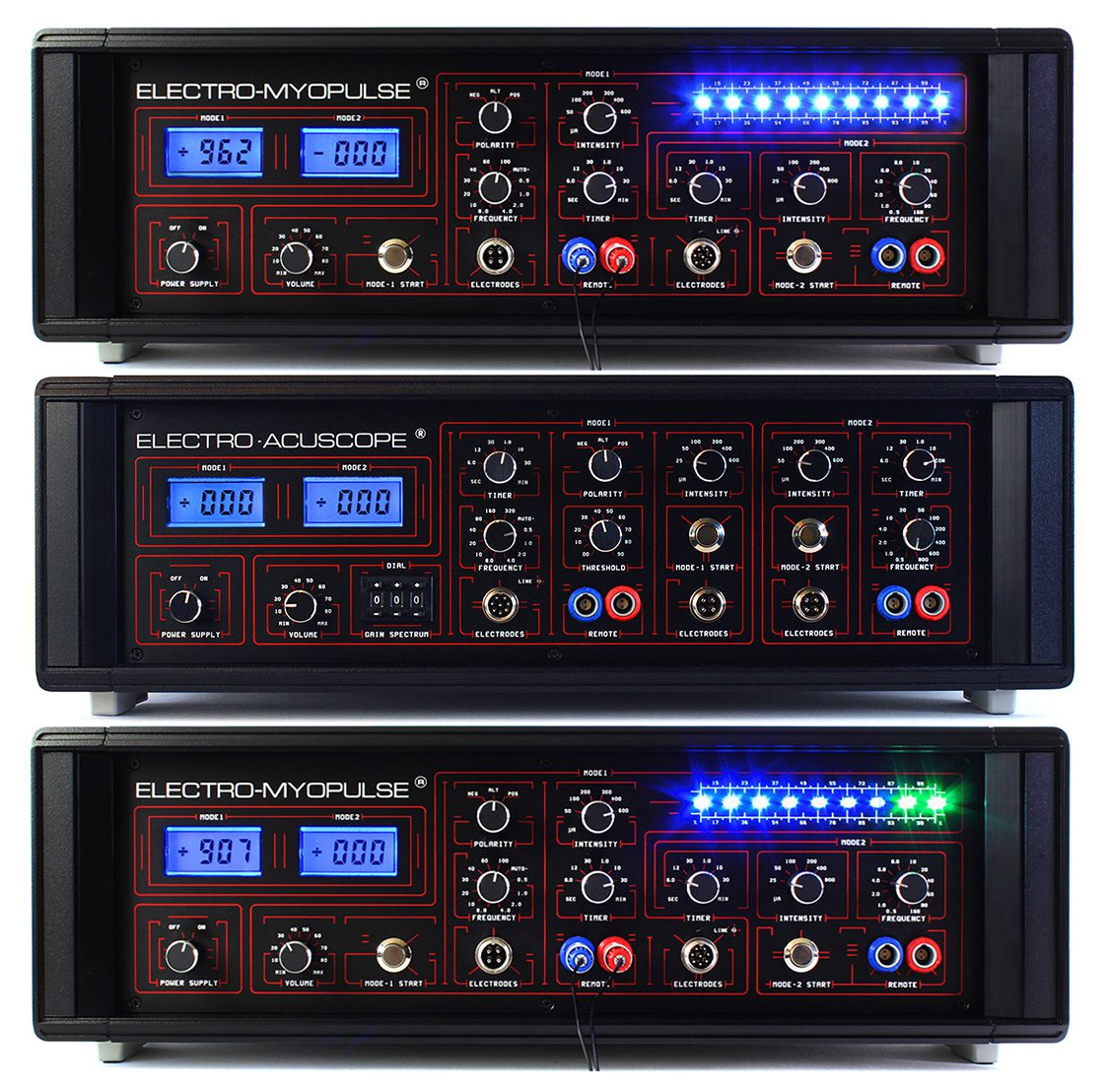
The Electro-Acuscope and the Myopulse are companion microcurrent instruments. The Acuscope was introduced in 1978 and the Myopulse in 1983. What sets them apart from most electrical devices is that they listen as well as speak: as the current alternates direction, the instruments measure the tissue’s impedance, its resistance to the flow of current, and use that reading to shape the next output (Dacri, n.d.).
According to the system’s training materials, the Acuscope pairs square-wave output with the nervous system, while the Myopulse pairs sine-wave output with muscle, tendon, ligament, and fascia. Both instruments are registered with the U.S. Food and Drug Administration, the Acuscope as a TENS device and the Myopulse as an electrical muscle stimulator (Dacri, n.d.).
Points Without Needles
Acupuncture reaches specific points on the body with needles, and acupressure reaches the same points with pressure. The Acuscope and Myopulse work from a different direction. They run on stored electricity from a rechargeable battery, and they deliver it through probes, rollers, or plate electrodes that rest on the skin, without breaking it. The training materials describe a rounded probe tip applied gently to acupoints, trigger points, and tender sites, so that a session can follow a map much like the one acupuncture uses (Dacri, n.d.).
Why would electrical instruments look for those points? Practitioners have long held that acupuncture points and meridians conduct electricity differently from the skin around them. A systematic review of 18 studies found that five of nine studies of points reported lower electrical resistance than nearby skin, and seven of nine studies of meridians reported lower impedance. The studies were generally small and of poor quality, and the authors concluded that the evidence does not conclusively show that points or meridians are electrically distinct, though the early findings are suggestive (Ahn et al., 2008).
Needling and pressure also act mechanically. In mouse connective tissue, turning an acupuncture needle made fibroblasts change shape within 30 minutes, a sign that cells respond actively to the pull (Langevin et al., 2006). Microcurrent at the same points works through a different input, electrical rather than mechanical, so findings from one do not transfer to the other.
Reading and Responding
According to the training materials, each instrument monitors the impedance of the tissue between two contact points, compares it with built-in norms, and adjusts its output; the probe polarity reverses every two seconds, so the instruments alternate between reading and treating. Both have digital displays, and the Acuscope also plays tones that change with the reading. The materials say the readouts show where tissue is inflamed or depleted (Dacri, n.d.). We treat those descriptions as the system’s own model, not as medical findings.
How we use it
This is the system behind our microcurrent work. Our dedicated microcurrent sessions run one to two hours and include tissue response testing, so each session follows what the readings show, and what you tell us, rather than a fixed script.
Where the evidence stands
The studies we found on these instruments are small and decades old. In a double-blind study of students with neck and shoulder trigger points, the treated group improved more than the placebo group (Chee & Walton, 1986), and a 1993 review noted that the efficacy of the Electro-Acuscope and two similar devices remained controversial (Dreyfuss et al., 1993). We have not found a study that compares self-adjusting output with fixed output. Microcurrent research in general is promising and uneven (Iijima & Takahashi, 2021).
Where It Sits in Our Frameworks
The Electro-Acuscope and Myopulse are where the Current signal and biofeedback meet: they deliver current and listen at the same time. They also bridge traditions. They borrow acupuncture’s map of the body and bring to it a modern electrical measure, while the body’s own electrical activity, studied as bioelectricity and endogenous electric fields, supplies the idea of working at a matching scale (Nuccitelli, 2003).
The research behind this entryReferences
Show sourcesHide sources
- Ahn, A. C., Colbert, A. P., Anderson, B. J., Martinsen, Ø. G., Hammerschlag, R., Cina, S., Wayne, P. M., & Langevin, H. M. (2008). Electrical properties of acupuncture points and meridians: A systematic review. Bioelectromagnetics, 29(4), 245–256. https://doi.org/10.1002/bem.20403
- Chee, E. K., & Walton, H. (1986). Treatment of trigger points with microamperage transcutaneous electrical nerve stimulation (TENS): The Electro-Acuscope 80. Journal of Manipulative and Physiological Therapeutics, 9(2), 131–134.
- Dacri, J. (n.d.). FAQ for the Acuscope, Myopulse, and Neuroscope. Acuscope Technology and Training. Retrieved October 21, 2026, from https://acuscopetraining.com/faq/
- Dreyfuss, P., Stratton, S., & Herring, S. A. (1993). The low-energy laser, Electro-Acuscope, and Neuroprobe. The Physician and Sportsmedicine, 21(8), 47–57. https://doi.org/10.1080/00913847.1993.11947587
- Iijima, H., & Takahashi, M. (2021). Microcurrent therapy as a therapeutic modality for musculoskeletal pain: A systematic review accelerating the translation from clinical trials to patient care. Archives of Rehabilitation Research and Clinical Translation, 3(3), Article 100145. https://doi.org/10.1016/j.arrct.2021.100145
- Langevin, H. M., Bouffard, N. A., Badger, G. J., Churchill, D. L., & Howe, A. K. (2006). Subcutaneous tissue fibroblast cytoskeletal remodeling induced by acupuncture: Evidence for a mechanotransduction-based mechanism. Journal of Cellular Physiology, 207(3), 767–774. https://doi.org/10.1002/jcp.20623
- Nuccitelli, R. (2003). A role for endogenous electric fields in wound healing. Current Topics in Developmental Biology, 58, 1–26. https://doi.org/10.1016/S0070-2153(03)58001-2