
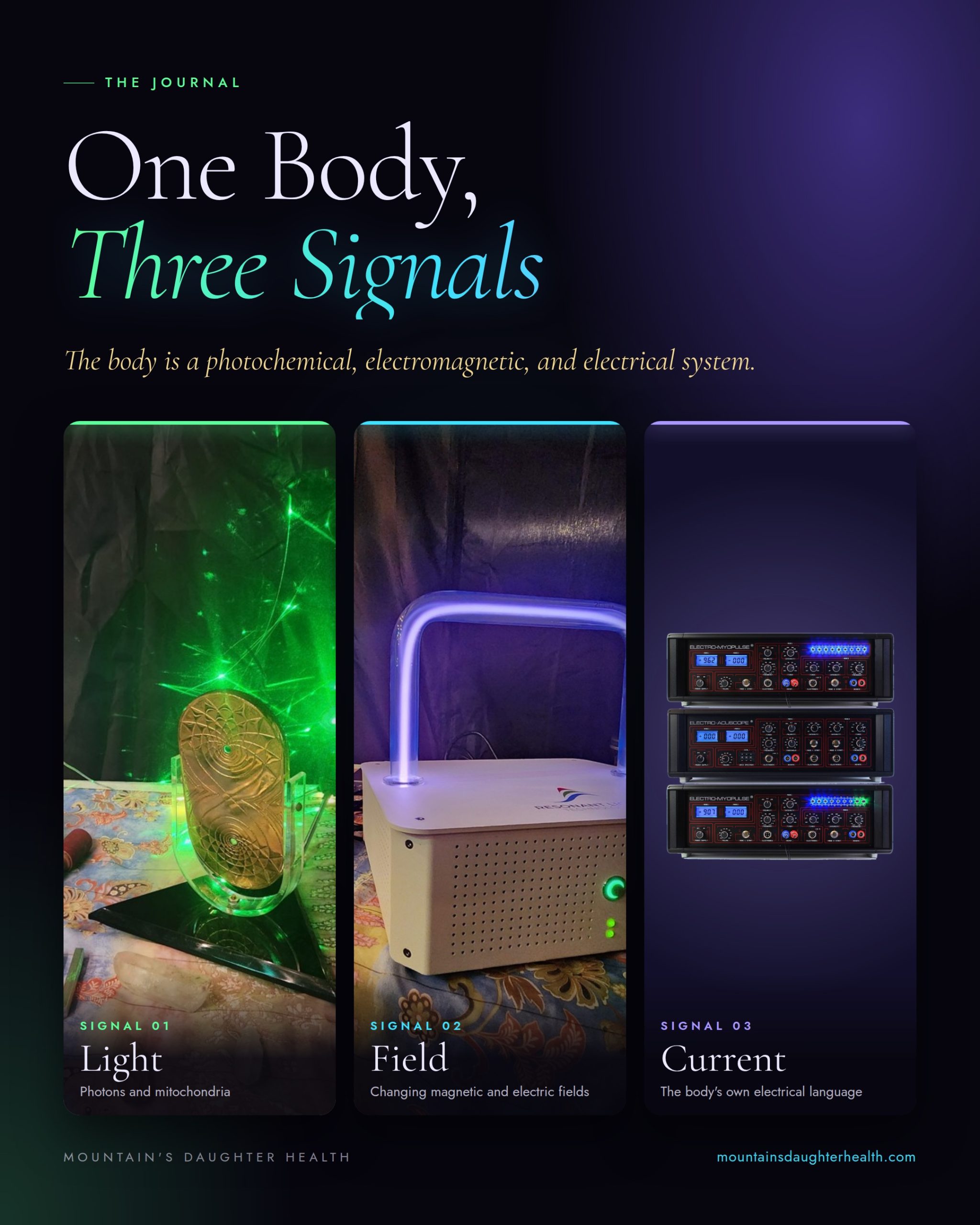
At Mountain’s Daughter Health, everything we build starts from one idea: the human body is simultaneously a photochemical, electromagnetic, and electrical system. It takes in light. It lives inside fields. It runs on current. We call these the Three Signals, and they shape every session, workshop, and installation we create.
A good Ozark farmer reads the light, the soil, and the water together, because the crop answers to all three at once. The body asks the same of us.
Signal One: Light
Light absorbed by molecules in the body, studied under photobiomodulation. The leading proposed mechanism centers on the mitochondria, where cytochrome c oxidase absorbs red and near-infrared light (de Freitas & Hamblin, 2016). The response is biphasic: too little light does little, and too much can work against you (Huang et al., 2009).
Key terms: Photobiomodulation, Cytochrome c Oxidase, Grotthuss-Draper Law, Light Dose, Near-Infrared Light, Light-Emitting Diode, Coherent Light, Melanopsin.
Signal Two: Field
Changing magnetic and electric fields that cross the skin without touching it, as in PEMF. A changing magnetic field induces small currents in tissue, and cell studies point to signaling through adenosine receptors and calcium (Cadossi et al., 2020). The clinical record is mixed: a 2020 meta-analysis found better fracture healing with PEMF than sham (Peng et al., 2020), while a 2024 review limited to acute fractures found no significant effect on healing (Picelli et al., 2024).
Key terms: PEMF, PERL, Endogenous Electric Fields, Galvanotaxis, Voltage-Gated Calcium Channels.
Signal Three: Current
The body’s own electrical language, met at a gentle scale through microcurrent. Skin holds a voltage across itself, and at a wound the escaping current forms a field that guides repairing cells (Nuccitelli, 2003; McCaig et al., 2005). Microcurrent works in the microampere range, below what most people can feel, closer to the body’s own bioelectric currents than a TENS unit (Iijima & Takahashi, 2021; Wadhwa et al., 2026). Its clinical evidence is small and uneven.
Key terms: Microcurrent, Bioelectricity, Electro-Acuscope and Myopulse, TENS, Auricular Vagus Nerve Stimulation, Fascia.
Where the Signals Meet
The three signals are distinct physics, and they converge inside the cell. Light and current both act on the mitochondria and both are measured through ATP. Field and current meet in the body’s endogenous electric fields. All three are studied with the same caution about dose: more is not automatically better.
The Thread That Ties Them Together
Biofeedback is the thread that ties them together. It is how a session listens to the person in front of us. In heart rate variability biofeedback, the breathing pace that produces the strongest response varies from person to person (Lehrer & Gevirtz, 2014), which is why we shape each session around the individual rather than a fixed protocol. The environment may matter too: in a small trial, the same relaxation program in immersive virtual reality lowered perceived stress more than on a screen (Nowakowska et al., 2026).
Key terms: Biofeedback, Heart Rate Variability, Cardiac Coherence.
Where it sits
Each signal holds claims at several tiers of the Evidence Gradient. The first step of photobiomodulation, absorption by cytochrome c oxidase, is well described; what follows is a leading hypothesis. The PEMF and microcurrent reviews studied clinical groups, and even there results are mixed, so for wellness use they sit in the mixed and emerging tiers at best. Our sessions are wellness experiences, not medical treatment, diagnosis, or cure for disease.
Where It Sits in Our Frameworks
The Three Signals describe what the body takes in. Auric Structuring describes the spaces and experiences we build around those signals, and the Coherence framework describes how those spaces are composed and perceived. Read the essay: One Body, Three Signals.
The research behind this entryReferences
Show sourcesHide sources
- Cadossi, R., Massari, L., Racine-Avila, J., & Aaron, R. K. (2020). Pulsed electromagnetic field stimulation of bone healing and joint preservation: Cellular mechanisms of skeletal response. JAAOS: Global Research & Reviews, 4, Article e19.00155. https://doi.org/10.5435/JAAOSGlobal-D-19-00155
- de Freitas, L. F., & Hamblin, M. R. (2016). Proposed mechanisms of photobiomodulation or low-level light therapy. IEEE Journal of Selected Topics in Quantum Electronics, 22(3), 348–364. https://doi.org/10.1109/JSTQE.2016.2561201
- Huang, Y.-Y., Chen, A. C.-H., Carroll, J. D., & Hamblin, M. R. (2009). Biphasic dose response in low level light therapy. Dose-Response, 7(4), 358–383. https://doi.org/10.2203/dose-response.09-027.Hamblin
- Iijima, H., & Takahashi, M. (2021). Microcurrent therapy as a therapeutic modality for musculoskeletal pain: A systematic review accelerating the translation from clinical trials to patient care. Archives of Rehabilitation Research and Clinical Translation, 3(3), Article 100145. https://doi.org/10.1016/j.arrct.2021.100145
- Lehrer, P. M., & Gevirtz, R. (2014). Heart rate variability biofeedback: How and why does it work? Frontiers in Psychology, 5, Article 756. https://doi.org/10.3389/fpsyg.2014.00756
- McCaig, C. D., Rajnicek, A. M., Song, B., & Zhao, M. (2005). Controlling cell behavior electrically: Current views and future potential. Physiological Reviews, 85(3), 943–978. https://doi.org/10.1152/physrev.00020.2004
- Nowakowska, A., Nowak, M., Bigas, J., Gaweł, Z., Nęcki, M., & Rutkowski, S. (2026). Short-term psychophysiological effects of immersive versus non-immersive relaxation in university students: A randomized controlled trial. Healthcare, 14(15), Article 2322. https://doi.org/10.3390/healthcare14152322
- Nuccitelli, R. (2003). A role for endogenous electric fields in wound healing. Current Topics in Developmental Biology, 58, 1–26. https://doi.org/10.1016/S0070-2153(03)58001-2
- Peng, L., Fu, C., Xiong, F., Zhang, Q., Liang, Z., Chen, L., He, C., & Wei, Q. (2020). Effectiveness of pulsed electromagnetic fields on bone healing: A systematic review and meta-analysis of randomized controlled trials. Bioelectromagnetics, 41, 323–337. https://doi.org/10.1002/bem.22271
- Picelli, A., Di Censo, R., Tomasello, S., Scaturro, D., Letizia Mauro, G., Smania, N., & Filippetti, M. (2024). Effects of pulsed electromagnetic fields on bone fractures: A systematic review update. European Journal of Physical and Rehabilitation Medicine, 60(6), 989–994. https://doi.org/10.23736/S1973-9087.24.08226-1
- Wadhwa, K., Singh, A. K., Bhatnagar, R. B., & Kapoor, K. (2026). Role of microcurrent electrical stimulation in tissue healing and scar modulation: A systematic review. The International Journal of Lower Extremity Wounds. Advance online publication. https://doi.org/10.1177/15347346261469606