
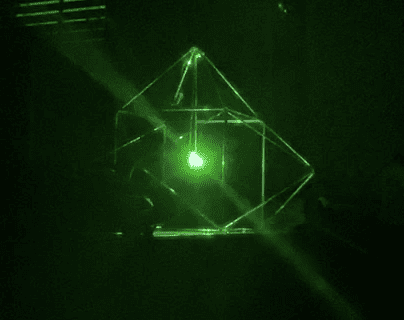
Pyramids have fascinated people for thousands of years, inspiring architectural, mathematical, spiritual, and scientific interpretations. In Auric Structuring™, the pyramid is a working form: gold geometric frames set with crystal that catch and redirect laser light. This entry separates the pyramid’s three lives, its history, its physics, and its meaning, so each can be told honestly.
The History of Pyramid Power
The modern movement grew from a Czechoslovak patent filed by Karel Drbal in 1949 and published in 1959, describing a pyramid-shaped enclosure meant to keep razor blades sharp (Drbal, 1959). A patent documents a proposed invention; it does not show that the invention works. The idea reached a wide English-speaking audience in 1970 through Psychic Discoveries Behind the Iron Curtain (Ostrander & Schroeder, 1970), and G. Patrick Flanagan’s Pyramid Power (1973) and Bill Schul and Ed Pettit’s The Secret Power of Pyramids (1975) extended the claims to food, plants, water, crystals, and human vitality.
Later authors carried the idea into esoteric territory. Fred Bell described pyramids, crystals, and wearable devices as transducers of subtle energy for healing and protection (Bell, 1999), and others linked pyramids to tachyons, scalar waves, and contact with other intelligences. These belong to the history of contemporary esoteric thought. They are documented here as what people have believed and taught, not as findings of physics.
What Was Tested
The movement prompted real experiments. Reports published in 1973 compared pyramid-shaped containers with other shapes for drying food and with controls for razor-blade sharpness and flower preservation, and did not find a reliable pyramid-specific effect (Alter, 1973; Simmons, 1973). A later critical examination in a Cuban physics journal likewise described the proposed pyramid energy as unsupported (González, 2008). Drying and preservation depend on airflow, humidity, temperature, and surface area, so changes seen in a pyramid need a fair comparison before they mean anything.
What Physics Can Say
A 2018 study modeled how the Great Pyramid of Giza interacts with radio waves roughly 200 to 600 meters long. Using simulations and multipole analysis, the researchers found electromagnetic resonances that concentrate energy within the pyramid’s chambers and the ground beneath it (Balezin et al., 2018). It is a legitimate result, and its scope matters. Resonance of this kind happens at wavelengths comparable to an object’s own size. The study modeled a structure about 140 meters tall; it did not test small pyramids, razor blades, food, human physiology, or any therapeutic effect. Concentrating energy is also not the same as generating it.
Scale changes everything
An installation pyramid is centimeters to a meter or two across, a million times larger than the wavelength of visible light. At that scale, light behaves geometrically: it reflects from faces, refracts through crystal, and casts shadows and lines (Hecht, 2017). That is how our pyramids work with light. A gold frame reflects a laser; a crystal seated inside splits it; the triangle gives the beams a shape to follow. These are optical effects, plain and visible, and they need no hidden energy to explain them.
Metals and color
Metals reflect light differently by color. Gold reflects red and infrared light strongly and absorbs more blue and green, which is why it looks golden (Hecht, 2017). Copper and gold frames therefore warm the light they return, part of why the color of a beam shifts as it meets the geometry.
How we use it
In Auric Structuring™, gold-plated pyramids set with crystals serve as geometric and reflective elements that interact with laser light, and as focal points for attention in sessions and installations. We draw on the pyramid’s distinctive form, its long human history, and its role in visual composition and contemplative practice. These uses are distinct from claims of therapeutic energy or biological effects, which would require their own evidence.
Where It Sits in Our Frameworks
Pyramidal geometry belongs to the Crystal element of Auric Structuring, where crystal and the geometry that holds it work together. In the Coherence framework, it is part of Coherence of Light, the physics of reflection and refraction, and of Luminous Architecture, the composition of form and beam. Its symbolism is declared as symbolism, at Tier IV of the Evidence Gradient, alongside our color language.
The research behind this entryReferences
Show sourcesHide sources
- Alter, A. (1973). The pyramid and food dehydration. New Horizons, 1, 92–94.
- Balezin, M., Baryshnikova, K. V., Kapitanova, P., & Evlyukhin, A. B. (2018). Electromagnetic properties of the Great Pyramid: First multipole resonances and energy concentration. Journal of Applied Physics, 124(3), Article 034903. https://doi.org/10.1063/1.5026556
- Bell, F. (1999). Rays of truth, crystals of light. Pyradyne.
- Drbal, K. (1959). Method of maintaining razor blades and straight razors sharp (Czechoslovak Patent No. 91304).
- Flanagan, G. P. (1973). Pyramid power. DeVorss & Company.
- González, J. L. Á. (2008). Experimentando con pirámides. Revista Cubana de Física, 25(1), 22.
- Hecht, E. (2017). Optics (5th ed.). Pearson.
- Ostrander, S., & Schroeder, L. (1970). Psychic discoveries behind the Iron Curtain. Prentice-Hall.
- Schul, B., & Pettit, E. (1975). The secret power of pyramids. Fawcett Gold Medal.
- Simmons, D. (1973). Experiments on the alleged sharpening of razor blades and the preservation of flowers by pyramids. New Horizons, 1, 95–101.