
Photobiomodulation, often shortened to PBM and once known as low-level laser or light therapy (LLLT), studies what happens when living tissue absorbs light at levels too gentle to heat it. The research uses low levels of visible or near-infrared light, and it has been explored for pain, inflammation, and healing for more than forty years (Huang et al., 2009).
The best-studied part of the story happens inside the mitochondria. An enzyme called cytochrome c oxidase absorbs light reaching into the near-infrared, and the leading hypothesis is that this absorption frees the enzyme from nitric oxide so electron transport and ATP production can rise (de Freitas & Hamblin, 2016). Dose matters as well. Low levels of light often do more good than high ones, a pattern called the biphasic dose response (Huang et al., 2009).
How we use it
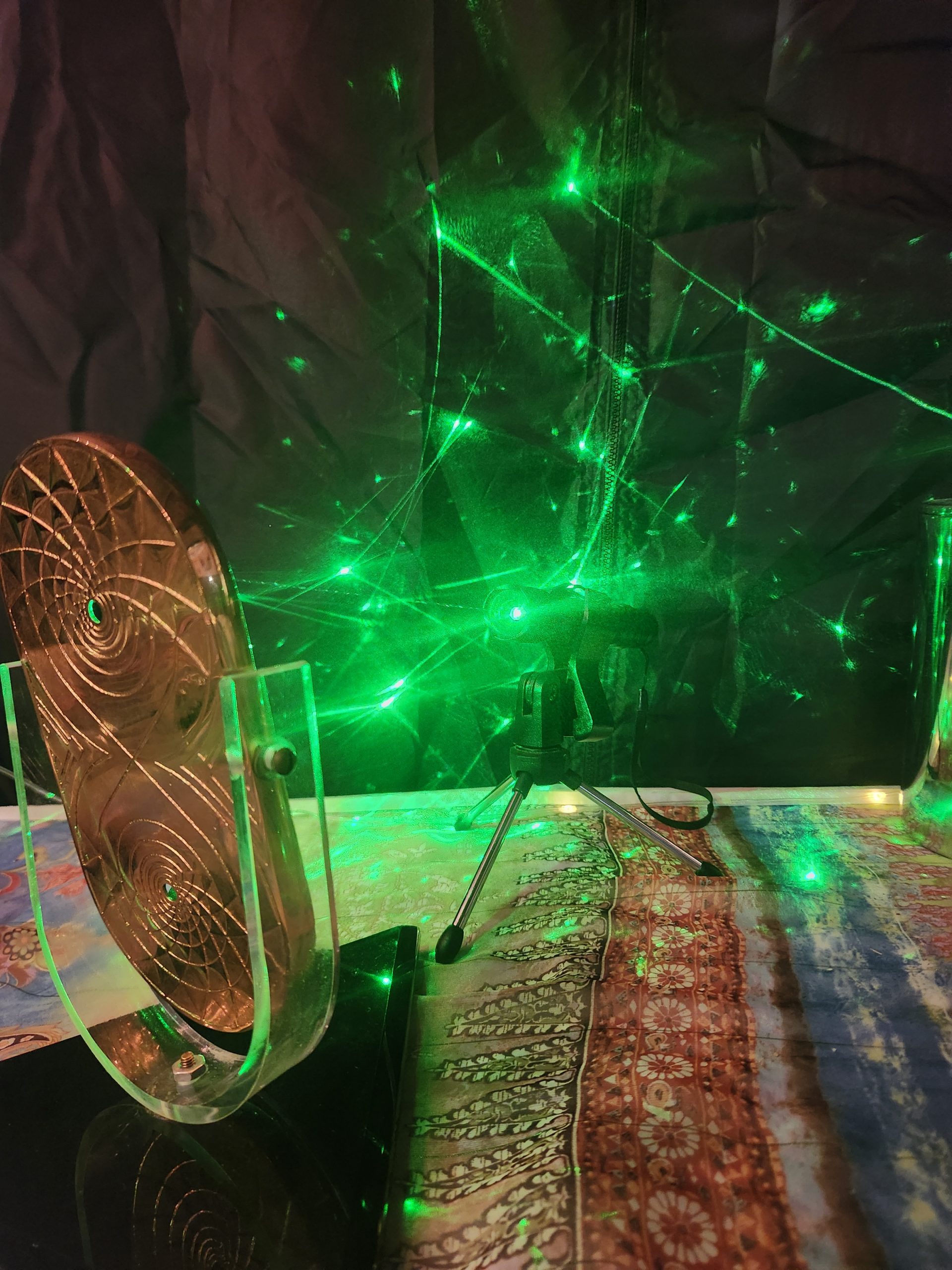
Photobiomodulation is the Light signal in the Three Signals. It shows up in our Auric Structuring sessions and in the laser and crystal jewelry we use in workshops, where red and green light meet crystal inside an intentional environment.
Where the evidence stands
PBM has been studied for decades, yet it still has not gained wide acceptance, largely because its mechanisms were uncertain for so long (de Freitas & Hamblin, 2016). The many settings a practitioner chooses, from wavelength and power to pulse and timing, have produced negative studies alongside positive ones (Huang et al., 2009). The absorption is well described. The outcomes people hope for are still being sorted out.
References
de Freitas, L. F., & Hamblin, M. R. (2016). Proposed mechanisms of photobiomodulation or low-level light therapy. IEEE Journal of Selected Topics in Quantum Electronics, 22(3), 348–364. https://doi.org/10.1109/JSTQE.2016.2561201
Huang, Y.-Y., Chen, A. C.-H., Carroll, J. D., & Hamblin, M. R. (2009). Biphasic dose response in low level light therapy. Dose-Response, 7(4), 358–383. https://doi.org/10.2203/dose-response.09-027.Hamblin