
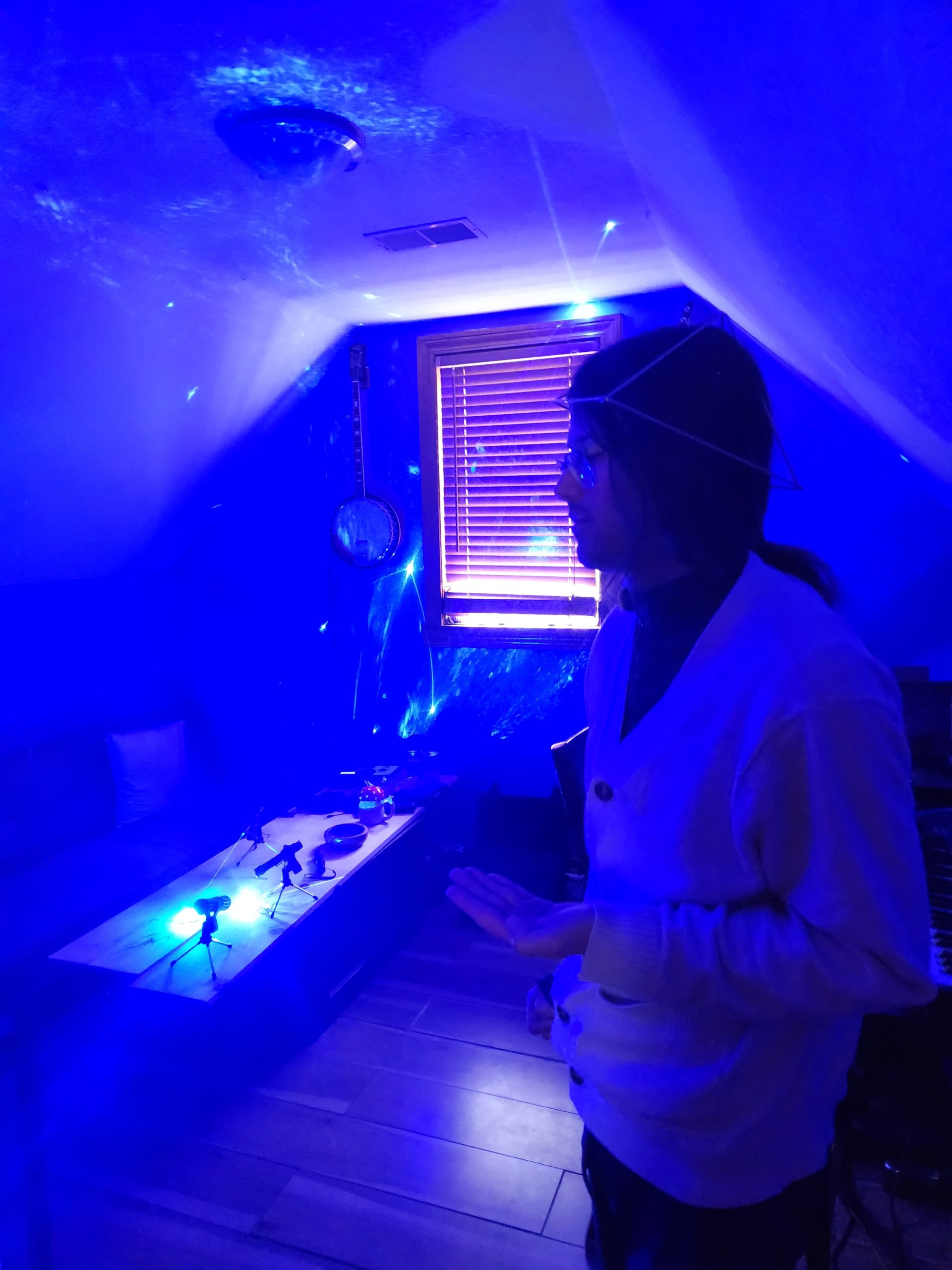
Auric Structuring™ is an experiential wellness and artistic framework exploring the relationship between light, crystalline structures, environment, and human experience. It is the overarching framework of our work. Each installation, session, and workshop is a modality or application within it.
Hang a crystal in a kitchen window and wait for morning. For a few minutes the light throws small rainbows across the room, and most people who notice stop for a moment. Auric Structuring begins in that moment: the same room, made different by the way light, crystal, and space meet.
The four elements
- Light: organized light, color, lasers, and illumination as experiential and environmental elements.
- Crystal: crystalline structures as forms of geometry, order, reflection, and symbolic coherence.
- Environment: the surrounding space, woven into the experience rather than serving as a backdrop.
- Human experience: the participant’s awareness, perception, emotion, reflection, and sense of presence.
In practice, Light means lasers and controlled light sources. Crystal includes mineral structures and the geometry that holds them: pyramids, lattices, and frames of copper, gold, and glass. Environment is the room or woods, the sound, and the dark between the beams. Human experience is the attention a person brings, drawn from traditions of aura awareness. Light passes through crystal rather than shining straight onto the skin.
What it can be paired with
Sessions can be paired with PEMF and the PERL resonant light system, or with microcurrent and biofeedback. Those belong to the Three Signals and are offered as their own wellness experiences, with their own place on the Evidence Gradient. They are companions to Auric Structuring, not elements of it, so the claims for each stay separate.
Where Field Fits
Auric Structuring is built from light, crystal, environment, and human experience. Field runs through all four. It enters the work in three ways, each with its own kind of evidence, and keeping them distinct is what lets all three be said honestly.
1. Light is a field
Light is an electromagnetic field: an electric and a magnetic field regenerating each other as they travel (Hecht, 2017). Visible light, the radio waves that carry a signal, and the pulsed magnetic fields of a PEMF device all belong to the same family. They differ in frequency, strength, and how they meet matter. Visible light oscillates hundreds of trillions of times a second, and the energy each photon carries rises with frequency (Hecht, 2017). PEMF devices pulse at far lower frequencies and work by inducing small currents in tissue rather than by being absorbed as light (Cadossi et al., 2020).
So every Auric Structuring space is already a field environment. The lasers are the part of the electromagnetic field a person can see, made visible as lines in haze and broken into color by crystal.
2. The fields a person brings
The body makes fields of its own. The electrical activity of heart and brain produces fields that can be recorded as electrocardiograms and electroencephalograms, and the magnetic fields that come with them as magnetocardiograms and magnetoencephalograms (Hammerschlag et al., 2015). They are extremely faint: the brain’s magnetic field was first recorded only inside a magnetically shielded room, with many readings averaged together (Cohen, 1968). Skin holds a voltage across itself, and at a wound that voltage drives a small field that guides repairing cells (Nuccitelli, 2003).
Every installation also sits inside the Earth’s own magnetic field, which ranges from about 25,000 to 65,000 nanotesla at the surface (National Centers for Environmental Information, 2022). Before any device is switched on, a person walks into a space already holding light, the Earth’s field, and their own.
3. The auric field, as experienced
The word field also has an experiential meaning in our work. Crystallization of the Aura speaks of the auric field, and Structural Coherence of the experiential field: what a person perceives around and within themselves as attention settles. In the Library, aura and light body remain tradition words, and biofield, a term proposed for research in 1992, remains a research word (Rubik et al., 2015). The auric field is perceived and declared as such, on Tier IV of the Evidence Gradient. It is not a claim that the body’s measured fields change inside the work.
The optional field layer
Sessions can add a field layer: PEMF, or the PERL resonant light system, whose glowing argon tube is also a light element in the room. The physics of induction is settled, and coil-based PEMF bone stimulators hold FDA approval for fractures that fail to heal (Cadossi et al., 2020). That evidence belongs to those devices, not to Auric Structuring. The PERL has not been tested in controlled trials, and the field it delivers to someone seated in an installation has not been measured. When a field layer is present, we name it, and its claims stay in the PEMF and PERL entries at their own tiers.
Field across the four elements
- Light: the visible part of the electromagnetic field.
- Crystal: quartz responds to fields and to pressure through piezoelectricity, but a crystal resting on a table produces no electricity of its own; its role in the field is optical, redirecting light. See Piezoelectricity.
- Environment: the Earth’s magnetic field, the space, and any optional PEMF or PERL layer.
- Human experience: the body’s own faint fields, and the auric field as a person perceives it.
Questions for future research
- What field strength does a seated or standing visitor actually receive from a PEMF or PERL layer?
- Do people report a different experience with the field layer on and off, when they do not know which it is?
- Do measures such as heart rate variability shift differently with and without it?
The progression
Light, crystal, and environment come together toward Structural Coherence, then the Crystallization of the Aura, then what we call experiential becoming.
- Structural Coherence: the organization and stabilization of the experiential field, coherence without (ordered light and crystal) and coherence within (settling into attention).
- Crystallization of the Aura: the foundational concept, the perceived organizing and strengthening of the auric field through light, crystal, color, environment, and embodied experience.
- Experiential becoming: the human-development heart of the practice: transformation, awareness, and flourishing.
The vocabulary around it
- Luminous Architecture: the design practice, the intentional composition of light, optics, geometry, material, and space.
- Environmental Coherence: how a person experiences the organization of a space, and how that can be studied.
- Photic Lustration: the immersive experience of clearing and renewal, its research agenda, and light as a symbolic threshold.
- The Three Signals: Light, Field, and Current, the ways the body takes in signals, which Auric Structuring draws on in sessions.
Where it shows up
- Personal sessions: coherent light, crystal, and geometric structure arranged around a person at rest, often paired with microcurrent or biofeedback.
- Creating a Portal of Light: an evening workshop for small groups, with a small-scale installation and hands-on work with laser and crystal pieces.
- The Portal of Light and Field of Becoming: walk-in installations of coherent light, crystal, and metal for festivals, retreats, and events.
Color as declared symbolism
Its color vocabulary is declared symbolism: green for renewal, red for vitality, crystal for coherence. These are meanings we have chosen and announce as meanings. They are not claims about what a wavelength does to the body. Light does have biology, and we write about it separately, under photobiomodulation and the Grotthuss-Draper law. Symbolism and mechanism are both real, and we never let one borrow the authority of the other.
Why the setting matters
The experience rests on findings from settings like ours. A World Health Organization scoping review of more than 900 publications concluded that the arts can potentially affect both mental and physical health, while noting that the quality of evidence varies (Fancourt & Finn, 2019). In a small randomized trial, relaxation delivered in immersive virtual reality lowered perceived stress more than the same program on a screen (Nowakowska et al., 2026), and in a pilot trial, time in a calm sensory room shifted a marker of the resting nervous system (Otsuka et al., 2025). Perception research adds why order matters: the mind groups light and form into wholes (Wagemans et al., 2012), people often prefer scenes that hang together (Kaplan & Kaplan, 1989), and ease of processing feeds a sense of beauty (Reber et al., 2004). None of these studies measured an Auric Structuring space.
Where it sits
Auric Structuring is art and experience first. On the Evidence Gradient it lives mainly at Tier IV, experiential wellness art. When it draws on science, such as photobiomodulation, we say where that science sits. It is not a medical treatment, a diagnosis, or a cure for anything. An environment that helps someone slow down, breathe, and feel present has value on its own terms.
The research behind this entryReferences
Show sourcesHide sources
- Cadossi, R., Massari, L., Racine-Avila, J., & Aaron, R. K. (2020). Pulsed electromagnetic field stimulation of bone healing and joint preservation: Cellular mechanisms of skeletal response. JAAOS: Global Research & Reviews, 4, Article e19.00155. https://doi.org/10.5435/JAAOSGlobal-D-19-00155
- Cohen, D. (1968). Magnetoencephalography: Evidence of magnetic fields produced by alpha-rhythm currents. Science, 161(3843), 784–786. https://doi.org/10.1126/science.161.3843.784
- Fancourt, D., & Finn, S. (2019). What is the evidence on the role of the arts in improving health and well-being? A scoping review (Health Evidence Network Synthesis Report No. 67). WHO Regional Office for Europe. https://www.ncbi.nlm.nih.gov/books/NBK553773/
- Hammerschlag, R., Levin, M., McCraty, R., Bat, N., Ives, J. A., Lutgendorf, S. K., & Oschman, J. L. (2015). Biofield physiology: A framework for an emerging discipline. Global Advances in Health and Medicine, 4(Suppl), 35–41. https://doi.org/10.7453/gahmj.2015.015.suppl
- Hecht, E. (2017). Optics (5th ed.). Pearson.
- Kaplan, R., & Kaplan, S. (1989). The experience of nature: A psychological perspective. Cambridge University Press.
- National Centers for Environmental Information. (2022, March 9). Geomagnetism frequently asked questions. National Oceanic and Atmospheric Administration. Retrieved October 21, 2026, from https://www.ncei.noaa.gov/products/geomagnetism-frequently-asked-questions
- Nowakowska, A., Nowak, M., Bigas, J., Gaweł, Z., Nęcki, M., & Rutkowski, S. (2026). Short-term psychophysiological effects of immersive versus non-immersive relaxation in university students: A randomized controlled trial. Healthcare, 14(15), Article 2322. https://doi.org/10.3390/healthcare14152322
- Nuccitelli, R. (2003). A role for endogenous electric fields in wound healing. Current Topics in Developmental Biology, 58, 1–26. https://doi.org/10.1016/S0070-2153(03)58001-2
- Otsuka, H., Irie, K., Kogata, T., Onitsuka, A., & Inadomi, H. (2025). Effects of sensory room intervention on autonomic function in healthy adults: A pilot randomized controlled trial. PLOS ONE, 20(4), Article e0319649. https://doi.org/10.1371/journal.pone.0319649
- Reber, R., Schwarz, N., & Winkielman, P. (2004). Processing fluency and aesthetic pleasure: Is beauty in the perceiver’s processing experience? Personality and Social Psychology Review, 8(4), 364–382. https://doi.org/10.1207/s15327957pspr0804_3
- Rubik, B., Muehsam, D., Hammerschlag, R., & Jain, S. (2015). Biofield science and healing: History, terminology, and concepts. Global Advances in Health and Medicine, 4(Suppl), 8–14. https://doi.org/10.7453/gahmj.2015.038.suppl
- Wagemans, J., Elder, J. H., Kubovy, M., Palmer, S. E., Peterson, M. A., Singh, M., & von der Heydt, R. (2012). A century of Gestalt psychology in visual perception: I. Perceptual grouping and figure-ground organization. Psychological Bulletin, 138(6), 1172–1217. https://doi.org/10.1037/a0029333