
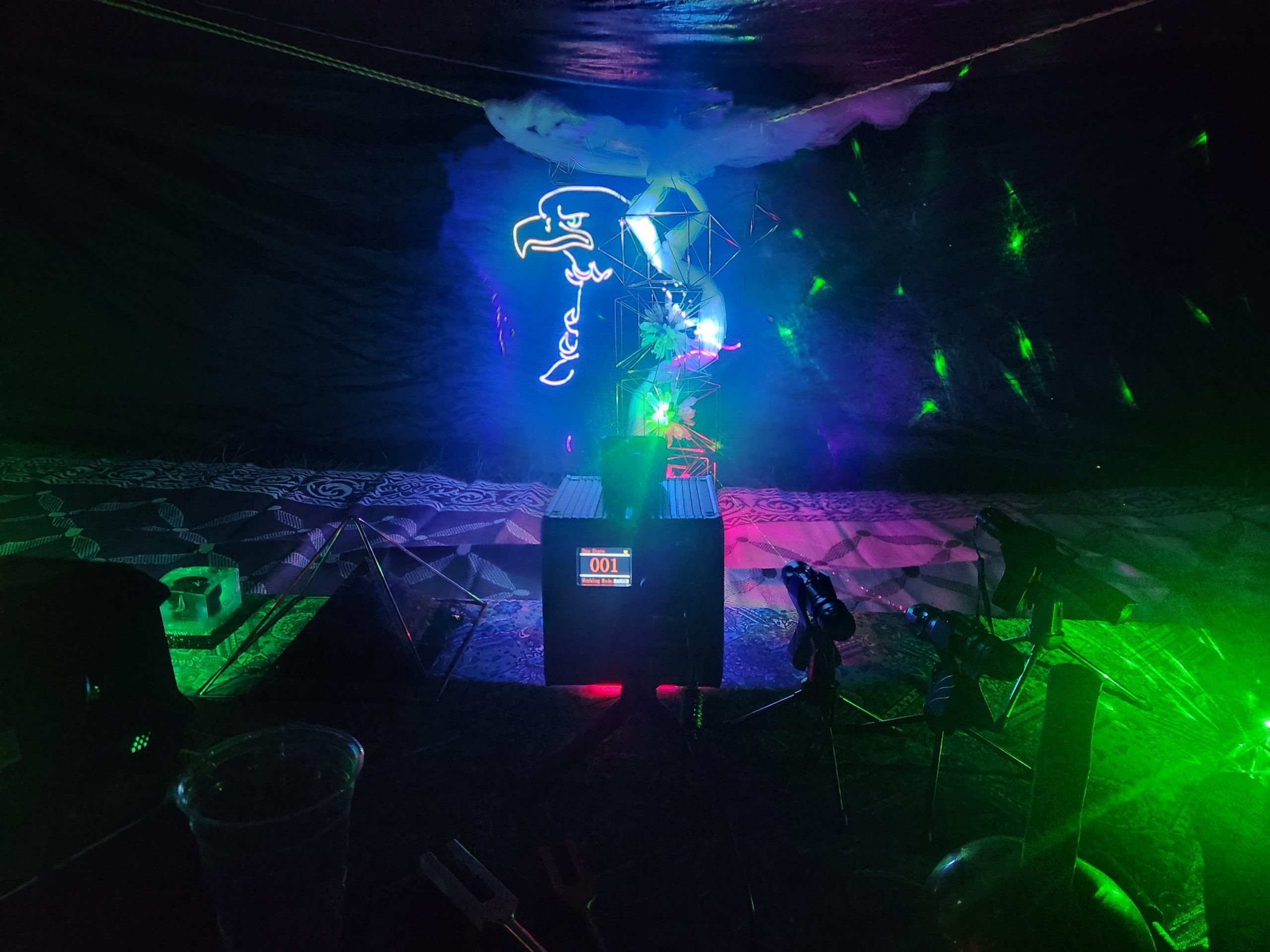
Luminous Architecture is the deliberate composition of light, optics, geometry, material, and spatial relationships to create an immersive sensory environment. It extends beyond conventional illumination by treating light as both a physical phenomenon and a medium of spatial expression. Rather than merely lighting a room, Luminous Architecture organizes how light appears, travels, intersects with surfaces, defines boundaries, and shapes the experience of being within a space.
How Light Becomes Architecture
The practice draws on principles from architectural lighting, optical physics, environmental psychology, and experiential design. Lasers provide narrow, directional beams with the physical properties of coherent light (Hecht, 2017). Refractive and reflective materials alter the paths and distribution of light according to their optical properties. Spatial geometry, contrast, movement, scale, and darkness determine how these elements are perceived in relation to one another. The resulting environment may be static or dynamic, contemplative or stimulating, minimal or densely layered.
A beam in perfectly clear air is hard to see from the side. It becomes visible when fog, haze, or dust scatters part of its light toward the viewer (Bohren & Huffman, 1983), which is how a fanned beam can read as a ceiling, a wall, or a doorway where no surface exists. The visual system then groups aligned, nearby, or co-moving beams into larger forms (Wagemans et al., 2012), and darkness makes them stand out, because what draws the eye depends on its surroundings (Itti & Koch, 2001).
A Vocabulary From Lighting Design
In 1952 the lighting designer Richard Kelly described three kinds of light that a designer composes, in this order (Kelly, 1952):
- Focal glow: the campfire, the follow spot, the pool of light at a reading chair. It draws attention and separates the important from the unimportant.
- Ambient luminescence: shadowless light, like a snowy morning or fog at sea. Kelly wrote that it suggests the freedom of space and can suggest infinity, and that it is usually reassuring and restful.
- Play of brilliants: crystal chandeliers, sunlight on a fountain, and trees laced with the beams of spotlights. Kelly wrote that it excites the eye and awakens curiosity.
Luminous Architecture uses all three: haze as ambient luminescence, a beam landing on a crystal as focal glow, and the scattered points of light a crystal throws across foliage as a play of brilliants.
What Lighting Research Shows
Decades of research show that the arrangement of light changes how a space is judged, not only how well people can see in it. In early experiments with 96 adults, lighting all four walls made a room feel more spacious than dim overhead lighting, and adding some wall light to overhead downlights made the room both more spacious and more pleasant; the authors described their findings as preliminary (Flynn et al., 1973). A later study with 100 participants found wall washing preferred for making a room feel spacious (Durak et al., 2007). Researchers also describe the atmosphere of a lit space along four dimensions, cosiness, liveliness, tenseness, and detachment, and find that perceived atmosphere can be predicted well from two qualities of the light, its overall brightness and how even it looks (Stokkermans et al., 2018). In a virtual office, 27 people rated their emotional responses to 17 combinations of brightness and color temperature and adjusted the lights themselves; the lighting they started with strongly shaped what they chose, and over repeated trials their preferences drifted toward dimmer light (Mostafavi et al., 2024). Light also carries meaning: a lighting design can be read as a set of signs, and semiotics offers designers a way to identify what their light communicates (Schielke, 2019).
Light Art and the Visitor
Research on light art itself is young. In a mock clinical setting, visitors to an exhibition of dynamic light-art installations described most of them as calming, peaceful, mesmerizing, beautiful, and intriguing; the study collected written responses and had no comparison group (Godley et al., 2024). Among 230 visitors to Tomás Saraceno’s walk-in installation in orbit, awareness of balance and movement predicted how much they appreciated the work, and unusual bodily sensations such as chills or feeling watched coincided with reports of transformation (Kühnapfel et al., 2023). In an environment people walk into, the body is part of the artwork.
Pattern and Color
Natural forms such as clouds, trees, and skylines are fractal, and preference studies point to a middle range of fractal complexity. In landscape silhouettes the most preferred fractal dimension was about 1.3 (Hagerhall et al., 2004), and across studies fractals with a dimension of 1.3 to 1.5 had the highest aesthetic appeal (Taylor et al., 2011). Crystal dispersion, branching fiber optics, and tree canopies can be designed toward that range, though whether doing so changes how visitors feel has not been tested in an installation.
For color, how bright and how saturated a color is predicted emotional response more strongly than its hue (Valdez & Mehrabian, 1994). A study of 4,598 people in 30 nations found color-emotion associations that were largely shared across cultures, with local differences (Jonauskaite et al., 2020). That is one reason MDH declares the meanings it gives its colors rather than treating them as universal.
Material and Meaning
At Mountain’s Daughter Health, Luminous Architecture also incorporates a symbolic vocabulary of material and form. Quartz may represent clarity, transmission, crystalline order, and the relationship between structure and light. Shungite may represent density, grounding, containment, and the material conditions of the earth. Their placement establishes a visual and spatial dialogue between luminosity and mass, transparency and opacity, emergence and stability. These meanings belong to the design philosophy; they should not be confused with demonstrated physiological or electromagnetic effects of the stones. Quartz is piezoelectric and shungite can shield microwave radiation when prepared as thin, carbon-rich plates, but neither property means a stone in a room changes the people around it (Antonets et al., 2021; International Union of Crystallography, n.d.).
What the Research Supports
The practice is informed by research showing that light affects visual perception, circadian timing, alertness, and mood (Xiao et al., 2021), by environmental-psychology research on restorative settings (Kaplan, 1995; Ulrich et al., 1991), and by the lighting research above. However, evidence for these broader relationships does not establish that a specific arrangement of lasers, crystals, or mineral objects produces a particular therapeutic outcome.
Design Principles
- Spatial legibility: deliberate visual relationships, focal points, transitions, and boundaries.
- Optical intentionality: beam direction, refraction, reflection, contrast, and visibility designed according to actual optical properties.
- Material dialogue: materials used for their physical properties and for stated symbolic meanings, with the two kept distinct.
- Sensory modulation: attention to intensity, movement, sound, complexity, duration, and individual sensory differences.
- Participant agency: the freedom to move, disengage, adjust exposure, and interpret the environment independently.
- Evaluability: design and exposure conditions documented so that experiences and possible physiological outcomes can be studied.
Safety
- Flicker: photosensitivity, an abnormal brain response to flashing light or patterns, occurs in about 0.3% to 3% of people, and seizures from light affect about 1 in 10,000 people, or 1 in 4,000 aged 5 to 24. Flashes of 15 to 25 Hz are the most provocative, and red light is also a factor (Fisher et al., 2005). See Flicker.
- Uniform fields: an evenly lit, featureless visual field, such as dense, evenly lit fog, can produce pseudo-hallucinatory images in most observers (Wackermann et al., 2008). Designs that fill the whole field of view should leave visitors a clear way out.
- Lasers: laser light shows in the United States are regulated, with limits on the power that may reach an audience (U.S. Food and Drug Administration, n.d.). In our installations, beams are positioned above and away from where people stand.
Conceptual principle: Light is not merely an object within the architecture. It is one of the media through which the architecture becomes perceptible.
Evidence status: The optical and photobiological principles underlying the practice are established, and lighting research shows that the arrangement of light changes how spaces are judged. Luminous Architecture, as defined here, is a Mountain’s Daughter Health design framework. Its specific experiential and physiological effects require evaluation.
Where to Go Next
- A Portal of Light in the Ozark Woods: Luminous Architecture in practice: a lit path, a ring of laser light, and a forest after dark.
- Auric Structuring™: the method that sets light, crystal, geometry, and attention together.
- Book Us: bring an immersive light installation to your event.
- Photic Lustration: the experience of passing through a composed light environment, and what it can mean.
- Environmental Coherence: how a space’s organization relates to the experience of being in it.
- Laser Hazard Classes: how laser power is rated for eye and skin safety.
- Flicker: why flashing and flickering light needs care in any installation.
- The Evidence Gradient: how we rate every claim in the Library, from established to experiential.
The research behind this entryReferences
Show sourcesHide sources
- Antonets, I. V., Golubev, Y. A., Shcheglov, V. I., & Sun, S. (2021). Electromagnetic shielding effectiveness of lightweight and flexible ultrathin shungite plates. Current Applied Physics, 29, 97–106. https://doi.org/10.1016/j.cap.2021.06.008
- Bohren, C. F., & Huffman, D. R. (1983). Absorption and scattering of light by small particles. Wiley.
- Durak, A., Camgöz Olguntürk, N., Yener, C., Güvenç, D., & Gürçınar, Y. (2007). Impact of lighting arrangements and illuminances on different impressions of a room. Building and Environment, 42(10), 3476–3482. https://doi.org/10.1016/j.buildenv.2006.10.048
- Fisher, R. S., Harding, G., Erba, G., Barkley, G. L., & Wilkins, A. (2005). Photic- and pattern-induced seizures: A review for the Epilepsy Foundation of America Working Group. Epilepsia, 46(9), 1426–1441. https://doi.org/10.1111/j.1528-1167.2005.31405.x
- Flynn, J. E., Spencer, T. J., Martyniuk, O., & Hendrick, C. (1973). Interim study of procedures for investigating the effect of light on impression and behavior. Journal of the Illuminating Engineering Society, 3(1), 87–94. https://doi.org/10.1080/00994480.1973.10732231
- Godley, L., Frasso, R., Igoe, T., Erel, Y., & LeNoir, J. (2024). The use of immersive light-based art for well-being. IOP Conference Series: Earth and Environmental Science, 1320(1), Article 012008. https://doi.org/10.1088/1755-1315/1320/1/012008
- Hagerhall, C. M., Purcell, T., & Taylor, R. (2004). Fractal dimension of landscape silhouette outlines as a predictor of landscape preference. Journal of Environmental Psychology, 24(2), 247–255. https://doi.org/10.1016/j.jenvp.2003.12.004
- Hecht, E. (2017). Optics (5th ed.). Pearson.
- International Union of Crystallography. (n.d.). Piezoelectricity. Online Dictionary of Crystallography. https://dictionary.iucr.org/Piezoelectricity
- Itti, L., & Koch, C. (2001). Computational modelling of visual attention. Nature Reviews Neuroscience, 2(3), 194–203. https://doi.org/10.1038/35058500
- Jonauskaite, D., Abu-Akel, A., Dael, N., Oberfeld, D., Abdel-Khalek, A. M., Al-Rasheed, A. S., Antonietti, J.-P., Bogushevskaya, V., Chamseddine, A., Chkonia, E., Corona, V., Fonseca-Pedrero, E., Griber, Y. A., Grimshaw, G., Hasan, A. A., Havelka, J., Hirnstein, M., Karlsson, B. S. A., Laurent, E., . . . Mohr, C. (2020). Universal patterns in color-emotion associations are further shaped by linguistic and geographic proximity. Psychological Science, 31(10), 1245–1260. https://doi.org/10.1177/0956797620948810
- Kaplan, S. (1995). The restorative benefits of nature: Toward an integrative framework. Journal of Environmental Psychology, 15(3), 169–182. https://doi.org/10.1016/0272-4944(95)90001-2
- Kelly, R. (1952). Lighting as an integral part of architecture. College Art Journal, 12(1), 24–30. https://doi.org/10.1080/15436322.1952.11466295
- Kühnapfel, C., Fingerhut, J., & Pelowski, M. (2023). The role of the body in the experience of installation art: A case study of visitors’ bodily, emotional, and transformative experiences in Tomás Saraceno’s “in orbit.” Frontiers in Psychology, 14, Article 1192689. https://doi.org/10.3389/fpsyg.2023.1192689
- Mostafavi, A., Xu, T. B., & Kalantari, S. (2024). Effects of illuminance and correlated color temperature on emotional responses and lighting adjustment behaviors. Journal of Building Engineering, 86, Article 108833. https://doi.org/10.1016/j.jobe.2024.108833
- Schielke, T. (2019). The language of lighting: Applying semiotics in the evaluation of lighting design. LEUKOS, 15(2–3), 227–248. https://doi.org/10.1080/15502724.2018.1518715
- Stokkermans, M., Vogels, I., de Kort, Y., & Heynderickx, I. (2018). Relation between the perceived atmosphere of a lit environment and perceptual attributes of light. Lighting Research & Technology, 50(8), 1164–1178. https://doi.org/10.1177/1477153517722384
- Taylor, R. P., Spehar, B., Van Donkelaar, P., & Hagerhall, C. M. (2011). Perceptual and physiological responses to Jackson Pollock’s fractals. Frontiers in Human Neuroscience, 5, Article 60. https://doi.org/10.3389/fnhum.2011.00060
- Ulrich, R. S., Simons, R. F., Losito, B. D., Fiorito, E., Miles, M. A., & Zelson, M. (1991). Stress recovery during exposure to natural and urban environments. Journal of Environmental Psychology, 11(3), 201–230. https://doi.org/10.1016/S0272-4944(05)80184-7
- U.S. Food and Drug Administration. (n.d.). Laser light shows. https://www.fda.gov/radiation-emitting-products/home-business-and-entertainment-products/laser-light-shows
- Valdez, P., & Mehrabian, A. (1994). Effects of color on emotions. Journal of Experimental Psychology: General, 123(4), 394–409. https://doi.org/10.1037/0096-3445.123.4.394
- Wackermann, J., Pütz, P., & Allefeld, C. (2008). Ganzfeld-induced hallucinatory experience, its phenomenology and cerebral electrophysiology. Cortex, 44(10), 1364–1378. https://doi.org/10.1016/j.cortex.2007.05.003
- Wagemans, J., Elder, J. H., Kubovy, M., Palmer, S. E., Peterson, M. A., Singh, M., & von der Heydt, R. (2012). A century of Gestalt psychology in visual perception: I. Perceptual grouping and figure-ground organization. Psychological Bulletin, 138(6), 1172–1217. https://doi.org/10.1037/a0029333
- Xiao, H., Cai, H., & Li, X. (2021). Non-visual effects of indoor light environment on humans: A review. Physiology & Behavior, 228, Article 113195. https://doi.org/10.1016/j.physbeh.2020.113195