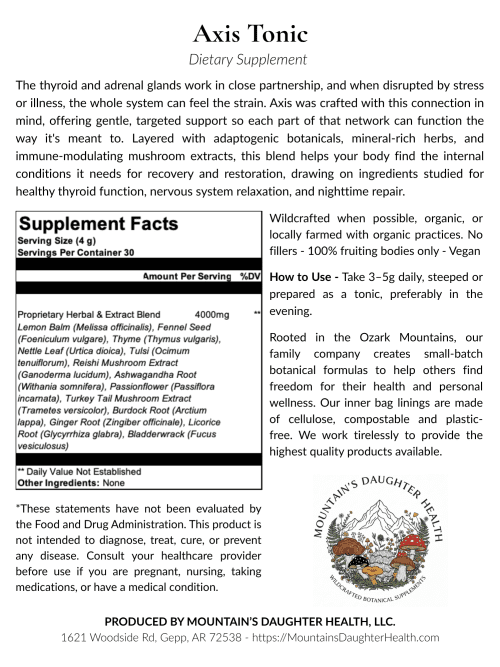
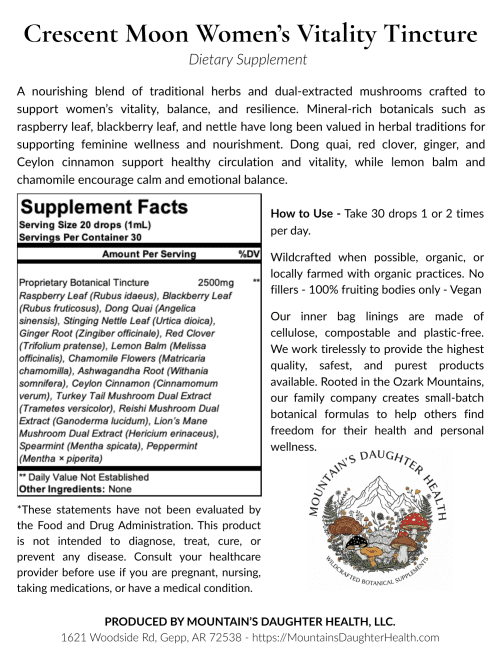
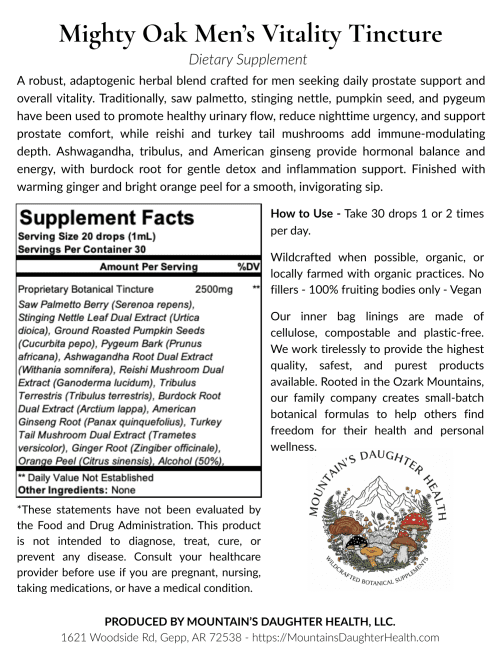
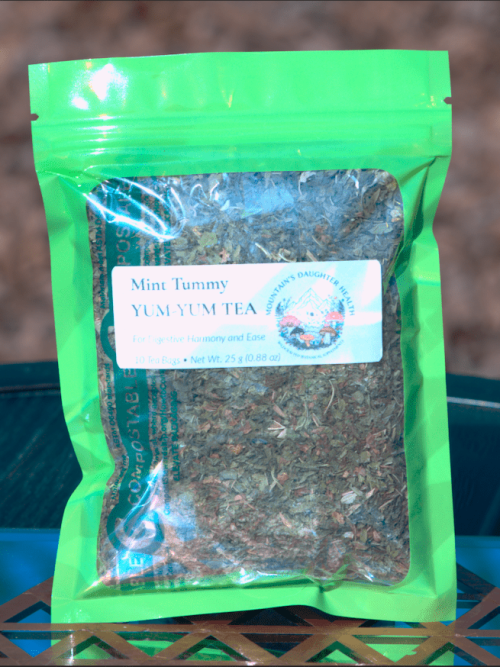
Stinging nettle (Urtica dioica) is a common plant of field edges and stream banks, famous for the sting of its fresh leaves. Herbalists use two parts differently: the leaf as a nourishing green and tea, and the root mainly in herbal traditions for men’s health. Our blends use both, so this page covers each.
Nettle Root
Nettle root is best studied for benign prostatic hyperplasia, the non-cancerous enlargement of the prostate that causes urinary symptoms in many older men. A comprehensive review found that the clinical evidence rests mostly on open studies without a comparison group, with a small number of randomized trials suggesting a proprietary root extract improves symptoms; how large the effect is, and how it works, remain uncertain. The same review found the risk of side effects very low (Chrubasik et al., 2007). In a later randomized trial of 60 men, a root extract taken for 12 weeks improved symptom scores more than placebo, with no side effects reported (Karami et al., 2020).
These results are for standardized root extracts in men with a diagnosed condition. They do not show what nettle does in a tea or tincture, and they are not a reason to delay seeing a doctor about urinary symptoms.
Nettle Leaf
Nettle leaf has been eaten as a spring green and brewed as a tea for centuries. In our blends it is there as a traditional nourishing herb. We do not make health claims for the leaf.
In Short
Nettle root has some trial evidence for prostate symptoms and a good safety record; nettle leaf is a traditional food plant. In our blends both are part of a nourishing daily ritual, not a treatment.
The research behind this entryReferences
Show sourcesHide sources
- Chrubasik, J. E., Roufogalis, B. D., Wagner, H., & Chrubasik, S. (2007). A comprehensive review on the stinging nettle effect and efficacy profiles. Part II: Urticae radix. Phytomedicine, 14(7–8), 568–579. https://doi.org/10.1016/j.phymed.2007.03.014
- Karami, A. A., Sheikhsoleimani, M., Memarzadeh, M. R., Haddadi, E., Bakhshpour, M., Mohammadi, N., & Mirhashemi, S. M. (2020). Urtica dioica root extract on clinical and biochemical parameters in patients with benign prostatic hyperplasia, randomized controlled trial. Pakistan Journal of Biological Sciences, 23(10), 1338–1344. https://doi.org/10.3923/pjbs.2020.1338.1344